Long-term macOS support and security practices
Long-term macOS Support and Security Practices: A Strategic Guide for Business Success

Running a Mac-based business in 2025 requires more than just buying Apple devices and hoping they’ll work forever. Smart business owners understand that long-term macOS support and security practices form the backbone of sustainable operations, protecting investments while maintaining peak performance year after year.
Whether you’re managing a creative studio with dozens of MacBooks or running a small agency with a handful of iMacs, the decisions you make today about system maintenance, security protocols, and hardware lifecycle planning will determine your technology costs and productivity for years to come.
Key Takeaways
• Proactive maintenance extends Mac lifespan by 3-5 years through regular system cleanups, software updates, and hardware monitoring
• Strategic hardware upgrades (SSD and RAM improvements) often provide better ROI than complete system replacement
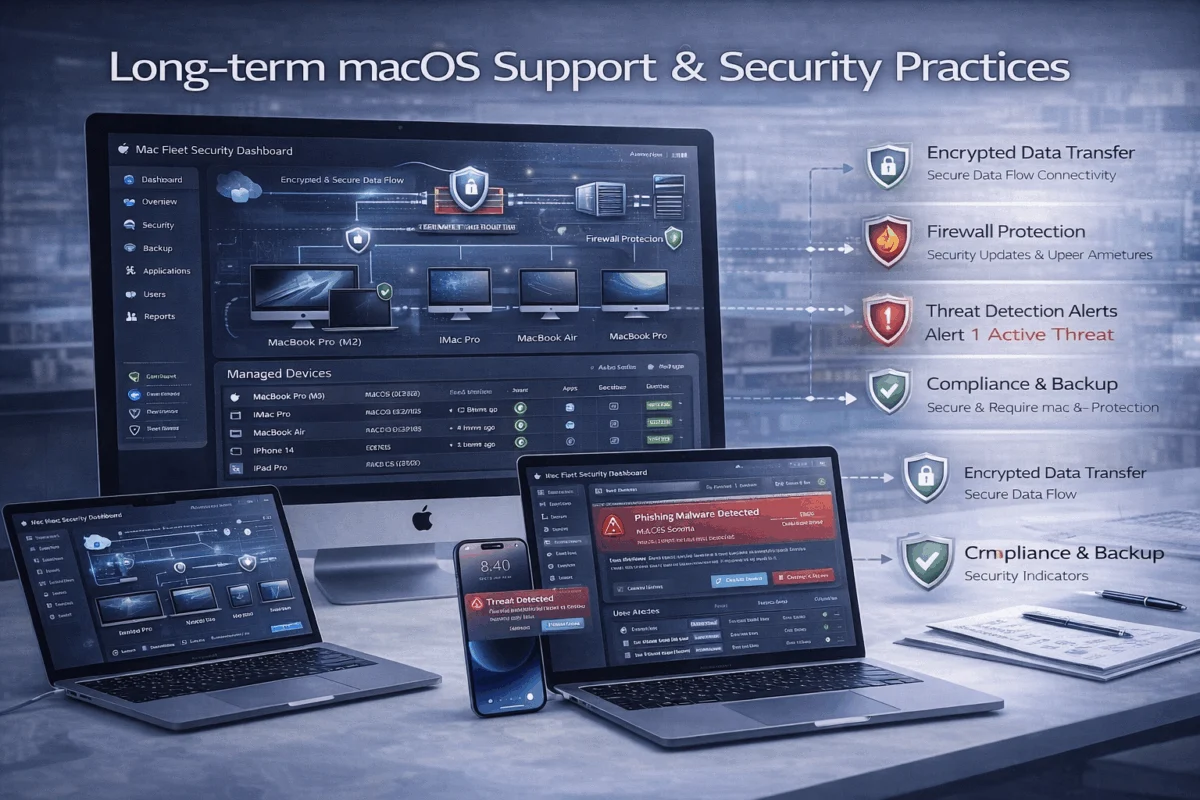
• Comprehensive security practices, including automated backups, access controls, and threat monitoring, protect business continuity
• Professional consulting relationships prevent costly downtime and provide predictable technology budgets
• Lifecycle planning helps businesses optimize replacement timing and avoid emergency purchases
Understanding macOS Lifecycle and Support Strategies

The Reality of Apple’s Support Cycles
Apple typically provides macOS security updates for 7-8 years after a system’s initial release, but this doesn’t mean your Mac will perform optimally throughout that entire period. Understanding these support cycles helps businesses make informed decisions about when to maintain, upgrade, or replace their Apple hardware.
Current macOS Support Timeline (2025):
- macOS Sonoma (2023): Full support until ~2030
- macOS Ventura (2022): Full support until ~2029
- macOS Monterey (2021): Security updates until ~2028
- macOS Big Sur (2020): Limited support ending ~2027
The key insight? Proactive planning during the first 5-6 years of ownership maximizes your investment while ensuring security compliance and optimal performance.
Building Your Long-term Support Framework
Successful long-term macOS support and security practices start with establishing clear protocols before problems arise. This means creating standardized procedures for system maintenance, security monitoring, and performance optimization that scale with your business growth.
Essential Framework Components:
- Regular maintenance schedules (weekly, monthly, quarterly tasks)
- Security monitoring and threat detection systems
- Automated backup verification and disaster recovery testing
- Hardware health monitoring and predictive maintenance
- Software license management and update coordination
Many businesses discover that staying current with technology prevents the accumulation of technical debt, which can become expensive to resolve later.
Proactive Maintenance Strategies That Extend Mac Longevity
System Optimization and Performance Monitoring
Regular system maintenance isn’t just about keeping things running—it’s about preserving the performance characteristics that made you choose Mac in the first place. Professional maintenance routines can extend your Mac’s usable life by 3-5 years while maintaining the speed and reliability your business depends on.
Weekly Maintenance Tasks:
- Disk usage analysis and cleanup
- Application crash log review
- Network connectivity testing
- Backup verification checks
- Security update installation
Monthly Deep Maintenance:
- Complete system diagnostic scans
- Storage optimization and file archival
- Application performance audits
- Hardware temperature monitoring
- User account and permissions review
Hardware Health and Predictive Maintenance
Modern Macs provide extensive diagnostic information that, when properly monitored, can predict hardware failures weeks or months in advance. This predictive approach allows businesses to plan replacements during convenient windows rather than dealing with emergency failures.
Critical Monitoring Points:
- SSD health and write cycles – Most business Macs show SSD wear after 4-5 years
- Battery cycle counts – MacBook batteries typically need replacement after 1000 cycles
- Thermal management – Overheating reduces component lifespan significantly
- RAM error detection – Memory issues often develop gradually before causing crashes
- Fan operation and dust accumulation – Poor cooling accelerates all component aging
Innovative businesses implement monitoring systems that track these metrics across their entire Mac fleet, enabling data-driven decisions about maintenance timing and hardware refresh cycles.
Software Lifecycle Management
Managing software updates across a Mac fleet requires balancing security, stability, and feature requirements. Apple’s approach to device longevity emphasizes long-term support, but businesses need strategies for managing the transition periods between major OS releases.
Update Strategy Best Practices:
- Staged rollouts – Test major updates on non-critical systems first
- Compatibility verification – Ensure business-critical applications work with new OS versions
- Rollback planning – Maintain the ability to revert problematic updates
- Security priority – Implement security updates immediately, feature updates strategically
Strategic Hardware Upgrades vs. Complete System Replacement
Cost-Benefit Analysis of Upgrade Options
The decision between upgrading existing Macs and purchasing new systems often determines whether your technology budget supports or undermines your business goals. Professional analysis of upgrade options frequently reveals opportunities to extend system life at 20-30% of replacement cost.
High-Impact Upgrade Opportunities:
| Upgrade Type | Cost Range | Performance Impact | Lifespan Extension |
|---|---|---|---|
| SSD Replacement | $200-800 | 300-500% speed increase | 2-3 years |
| RAM Expansion | $100-600 | 50-200% multitasking improvement | 2-4 years |
| External GPU | $300-1500 | 200-800% graphics performance | 1-3 years |
| Professional Cleaning | $150-300 | 10-30% thermal improvement | 1-2 years |
When Replacement Makes More Sense
While upgrades often provide excellent value, certain situations favor complete system replacement. Understanding these decision points prevents throwing good money after bad while ensuring your team has the tools they need for peak productivity.
Replacement Indicators:
- Logic board issues – Motherboard problems rarely justify repair costs
- Multiple component failures – When several systems fail simultaneously
- Software compatibility gaps – When business applications require newer hardware
- Performance bottlenecks – When upgrades can’t address fundamental limitations
- Total cost of ownership – When maintenance costs exceed replacement value
The key insight: Strategic timing of replacements during Apple’s refresh cycles often provides 20-40% better value than emergency purchases.
Comprehensive Security Framework for Mac Fleets
Multi-Layered Security Architecture
Adequate long-term macOS support and security practices require thinking beyond basic antivirus software. Modern Mac security involves multiple protection layers that work together to prevent, detect, and respond to various threat types while maintaining the user experience that makes Mac attractive for creative and business work.
Security Layer Components:
Access Control & Identity Management
- Multi-factor authentication for all business accounts
- Centralized user provisioning and deprovisioning
- Role-based access controls for sensitive data
- Regular access audit and cleanup procedures
Endpoint Protection & Monitoring
- Real-time threat detection and response
- Network traffic analysis and filtering
- Application behavior monitoring
- Automated security policy enforcement
Data Protection & Recovery
- Encrypted local and cloud backup systems
- Point-in-time recovery capabilities
- Disaster recovery testing and validation
- Secure data destruction for retired devices
Understanding how to protect yourself from various security threats becomes crucial as businesses increasingly rely on cloud services and remote work arrangements.
Automated Security Monitoring and Response
Manual security management doesn’t scale effectively as Mac fleets grow. Professional security frameworks implement automated monitoring that provides 24/7 protection while reducing the administrative burden on business owners and their teams.
Automated Security Features:
- Continuous vulnerability scanning across all managed devices
- Behavioral analysis that detects unusual user or system activity
- Automatic patch management for operating system and application updates
- Incident response workflows that contain threats before they spread
- Compliance reporting for industry-specific security requirements
Many businesses find that implementing strong digital security practices early prevents the much higher costs associated with security incidents and data breaches.
Backup Strategy and Business Continuity
No security framework is complete without comprehensive backup and recovery capabilities. The goal isn’t just protecting against ransomware or hardware failure—it’s ensuring your business can continue operating regardless of what happens to individual devices or systems.
Backup Architecture Best Practices:
- 3-2-1 Rule Implementation – Three copies of data, two different media types, one offsite
- Automated verification – Regular testing ensures backups actually work when needed
- Rapid recovery capabilities – Minimizing downtime during incident response
- Version control – Ability to recover from various points in time
- Cross-platform compatibility – Ensuring data accessibility regardless of hardware changes
Building Long-term Consulting Relationships for Sustainable Success
 The Value of Proactive IT Partnerships
Managing long-term macOS support and security practices internally often becomes overwhelming as businesses grow. Professional IT consulting relationships provide expertise, monitoring, and support that prevent minor issues from becoming expensive problems while ensuring your technology infrastructure scales smoothly with business growth.
Partnership Benefits:
- Predictable technology budgets through proactive planning and maintenance
- 24/7 monitoring and support that catches issues before they impact productivity
- Strategic technology planning aligned with business goals and growth projections
- Vendor relationship management for better pricing and priority support
- Compliance assistance for industry-specific security and data protection requirements
The difference between reactive and proactive support often determines whether technology enables or constrains business growth. Practical solutions with educational value help business owners understand their technology investments while maintaining focus on core business activities.
Customized Infrastructure Planning
One-size-fits-all IT solutions rarely work for creative businesses and growing companies. Effective consulting relationships begin with understanding your specific workflows, security requirements, and growth plans, and then designing technology infrastructure that efficiently supports those goals.
Custom Planning Elements:
- Workflow analysis – Understanding how your team actually uses technology
- Security risk assessment – Identifying vulnerabilities specific to your business model
- Growth projection planning – Ensuring technology scales with business expansion
- Budget optimization – Balancing current needs with future requirements
- Integration strategy – Connecting Mac systems with other business tools and services
Measuring Success and ROI
Professional Mac support relationships should provide measurable value that justifies their cost. The best partnerships deliver quantifiable improvements in system reliability, security posture, and user productivity while reducing total technology costs over time.
Success Metrics:
- System uptime improvement – Reduced downtime and productivity losses
- Security incident reduction – Fewer breaches, malware infections, and data losses
- Hardware lifespan extension – Getting more years from existing investments
- Support ticket reduction – Less time spent on technology problems
- User satisfaction scores – Improved employee experience with technology tools
Understanding when professional support provides better value than internal management helps businesses make informed decisions about their technology strategies.
Conclusion: Securing Your Competitive Advantage Through Strategic Mac Management
Long-term macOS support and security practices aren’t just about keeping computers running—they’re about building technology infrastructure that enables business success while protecting valuable data and investments. The businesses that thrive in 2025 and beyond will be those that implement proactive maintenance, strategic security frameworks, and professional support relationships before problems arise.
Your next steps should include:
- Audit your current Mac fleet – Document hardware ages, software versions, and maintenance history
- Implement basic monitoring – Set up automated alerts for system health and security issues
- Establish maintenance schedules – Create regular procedures for system optimization and security updates
- Plan hardware refresh cycles – Develop strategic timelines for upgrades and replacements
- Evaluate support options – Consider whether professional consulting provides better value than internal management
The investment you make in proper Mac support and security today will determine your technology costs, productivity levels, and competitive position for years to come. Don’t wait for problems to force expensive emergency decisions—take control of your technology destiny through strategic planning and proactive management.
Remember: Peace of mind through technology solutions comes from building systems that work reliably, scale efficiently, and protect your business from both technical failures and security threats. Your Mac investment deserves the professional attention that maximizes its value and minimizes your risks.
References
[1] Apple Inc. “macOS Security Updates and Support Lifecycle.” Apple Support Documentation, 2025.
[2] Gartner Research. “Total Cost of Ownership Analysis for Mac Fleet Management.” Technology Research Report, 2024.
[3] Cybersecurity & Infrastructure Security Agency. “Small Business Cybersecurity Guidelines.” CISA.gov, 2024.
Want this Mac Security implemented for you?
MacWorks 360 hardens, monitors, and backs up Mac fleets across New Jersey. We build policies, deploy tools, and prove restores—so your team stays safe and focused.
Contact us · Managed IT for Mac · Apple IT Support.
Based in Springfield, NJ—serving Summit, Millburn, Short Hills, Chatham, Montclair, and beyond.