Last updated: August 16, 2026
Quick Answer: When evaluating AI tools for business use, the single most important contractual clause is whether the vendor uses your data to train or improve their models. If the answer is not an unambiguous “no” in writing, the tool is not appropriate for professional or enterprise use. This applies to any business handling client data, financial records, legal documents, or internal strategy — regardless of company size.
Key Takeaways
- Consumer and free-tier AI tools almost universally reserve the right to use your conversations for model training. That trade-off is not acceptable for business use.
- Once your data is embedded in a model’s weights, it cannot be deleted or reversed. There is no undo function.
- The Samsung ChatGPT incident in 2023 demonstrated how proprietary data can leak through AI tools in ways that are difficult to contain after the fact.
- Enterprise platforms should offer 100% data isolation as a contractual commitment, not just a marketing claim.
- Five specific questions should be asked of every AI vendor before signing any agreement.
- Compliance-sensitive industries — law, finance, healthcare, and HR — face professional obligation risks, not just business risks, when using ungoverned AI tools.
- Evaluating AI tools means asking both “does it work?” and “is it safe and compliant for how the business actually operates?”
Why the Training Data Clause Is the Most Important Line in Any AI Contract
When evaluating any AI tool for business use, the training data clause deserves more scrutiny than pricing, uptime guarantees, or feature lists. The question is simple: does this vendor use your data to train or improve their models? If the answer is not a clear, contractual “no,” the tool carries risks that most businesses have not fully accounted for.
This is not purely a privacy concern. It is a business risk with consequences that are difficult to reverse.
When data is used to train a model, it becomes embedded in that model’s weights and responses. There is no delete function. There is no way to “un-train” a model once your information has been incorporated. If a competitor, researcher, or skilled prompt engineer later extracts information derived from your data — client lists, pricing strategy, internal processes — there is no practical recourse after the fact.
The Samsung Incident: A Real-World Example
This is not a hypothetical scenario. In 2023, Samsung engineers accidentally leaked proprietary chip design details through ChatGPT. That data was potentially used in model training. Samsung subsequently banned the use of generative AI tools on company devices. The incident was widely reported and serves as a concrete example of how quickly proprietary information can leave an organization through an AI interface.
For businesses in law, finance, healthcare, or HR, the stakes extend beyond competitive exposure. Confidentiality is a professional obligation in those fields, not a preference. Using an AI tool that trains on client conversations is not just a data governance gap — it is a potential compliance violation.
What “100% Data Isolation” Actually Means in Practice
Enterprise AI platforms that take data governance seriously are explicit about their commitments. A vendor operating at the appropriate standard for business use should be able to confirm, in writing, that:
- Your data never touches another customer’s environment.
- Your data is never used to train or fine-tune any model.
- Your data is never accessible outside your organization.
That is a contractual commitment, not a marketing claim. It is also the standard that any AI vendor handling business data should be held to.
The distinction between a marketing statement and a contractual commitment matters. A vendor can say “we take privacy seriously” in a blog post and still reserve the right to use your data for training in the actual terms of service. Reading the contract is the only way to know which category a vendor falls into.
For businesses working to build stronger digital security practices, reviewing AI vendor contracts is one of the most practical steps available. Resources like this guide to improving digital security habits and this overview of identifying phishing risks provide useful context for understanding the broader threat landscape that AI governance sits within.
The Five Questions to Ask Every AI Vendor Before You Sign
These questions should be asked in writing, and the answers should be in writing. Verbal reassurances from a sales representative are not sufficient.
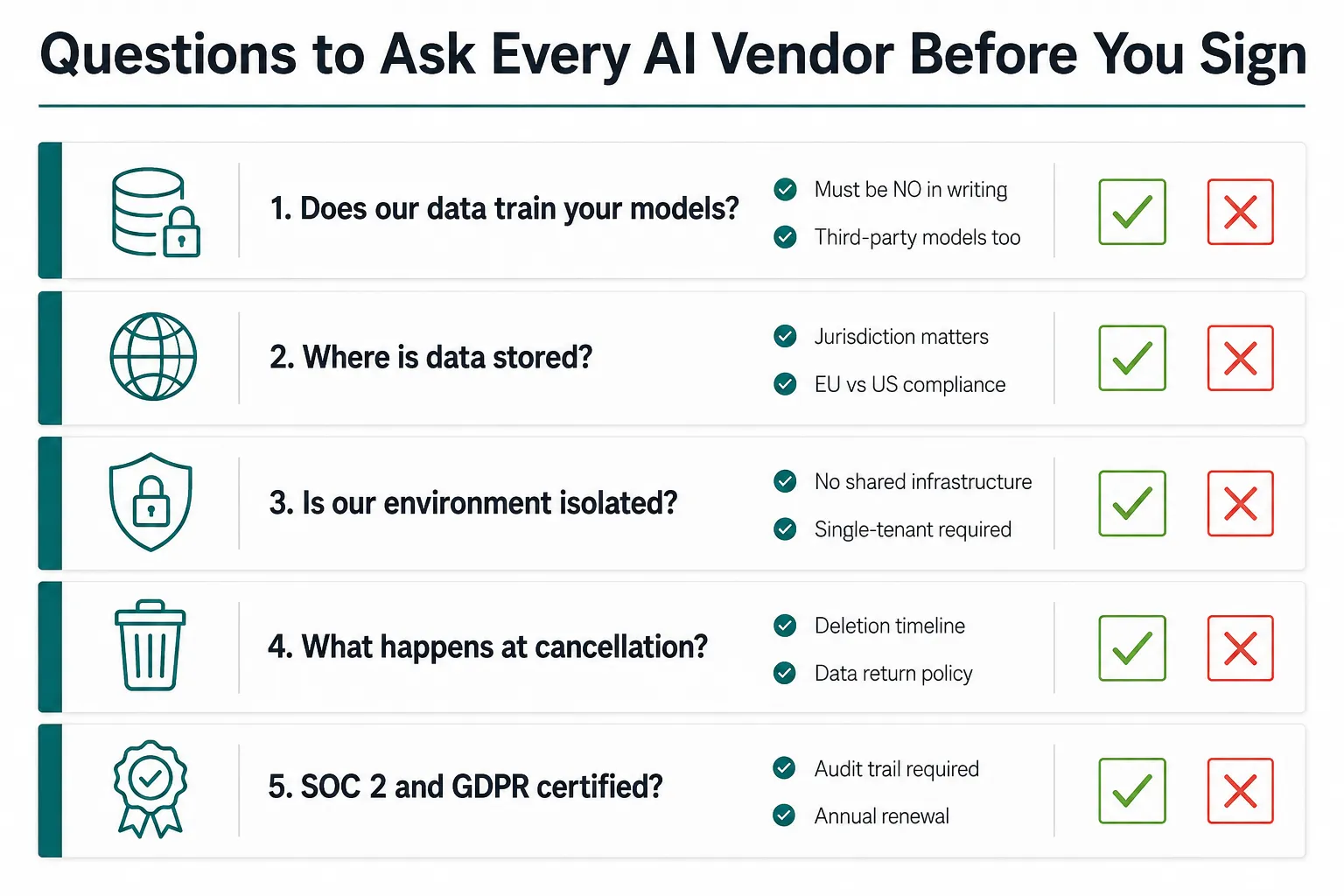
- Does our data train your models, or any third-party models?
- Where is our data stored, and in what jurisdiction?
- Is our data environment isolated from other customers?
- What happens to our data if we cancel the service?
- Are you SOC 2 certified and GDPR compliant?
If a vendor cannot answer all five questions clearly and in writing, that response itself is informative. Vendors with strong data governance policies answer these questions quickly because they have already documented the answers. Vendors who hedge or redirect are telling you something important about how they treat your data.
Given the scale of recent credential and data exposure incidents — detailed in resources like this breakdown of the 16 billion password breach and this post on the Mother of All Breaches — the risk environment for business data has never been more consequential. AI tool selection is now part of that risk picture.
How MacWorks 360 Helps Businesses Evaluate AI Tools
Part of what MacWorks 360 does is help clients evaluate technology decisions with both effectiveness and safety in mind. The question is never just “does this tool work?” It is also “is it safe, is it compliant, and does it fit how the business actually operates?”
AI vendor evaluation can be part of that conversation. A structured review of the business’s data, workflows, and governance requirements makes the vendor evaluation process more straightforward.
If formalizing an AI setup is on the agenda, the right place to start is a conversation about what the business actually needs, what data it handles, and what governance standards apply.
MacWorks 360 | macworks360.com | 973-671-1122
FAQ
What is the most important clause to check in an AI vendor contract?
The training data clause. It determines whether the vendor uses your business data to improve their models. If the answer is not an unambiguous “no” in writing, the tool is not appropriate for professional use.
Can data be removed from an AI model after it has been trained on it?
No. Once data is embedded in a model’s weights, it cannot be deleted or reversed. There is no mechanism to “un-train” a model, which is why preventing training on business data in the first place is the only reliable protection.
What happened with Samsung and ChatGPT?
In 2023, Samsung engineers accidentally leaked proprietary chip design details through ChatGPT. That data was potentially used in model training. Samsung subsequently banned generative AI tools on company devices.
What does 100% data isolation mean?
It means your data never touches another customer’s environment, is never used to train or fine-tune any model, and is never accessible outside your organization. It should be a contractual commitment, not a marketing statement.
What questions should I ask an AI vendor before signing a contract?
Ask whether your data trains their models, where data is stored and in what jurisdiction, whether your environment is isolated from other customers, what happens to your data at cancellation, and whether the vendor holds SOC 2 certification and GDPR compliance.
What industries face the highest risk from ungoverned AI tool use?
Law, finance, healthcare, and HR face the highest risk because confidentiality is a professional obligation in those fields, not just a business preference. Using an AI tool that trains on client conversations can constitute a compliance violation in those contexts.