Last updated: August 16, 2026
Quick Answer
AI data compliance in New Jersey means ensuring that every AI tool your business uses meets applicable data security, privacy, and transparency standards, including SOC 2, GDPR (where EU residents are involved), and the EU AI Act (now fully in effect as of August 2026). New Jersey does not yet have a standalone state AI law, but NJ businesses handling client data are already subject to multiple overlapping federal and international frameworks. Businesses that cannot document how their AI tools handle sensitive data face growing exposure from enterprise clients, insurers, and regulators.
Key Takeaways
- SOC 2 certification means an independent auditor has verified a vendor’s data security controls. If your AI vendor is not SOC 2 certified, you are relying on their self-reporting.
- GDPR applies to any NJ business that handles personal data belonging to EU residents, regardless of company size or location.
- The EU AI Act became fully applicable in August 2026 and categorizes AI systems by risk level. High-risk use cases (HR decisions, financial assessments, legal evaluations) face the strictest obligations.
- New Jersey does not currently have a dedicated state AI law, but the New Jersey Data Privacy Act (NJDPA), signed into law in January 2024, creates consumer data rights that overlap significantly with AI use cases.
- Small and mid-size NJ businesses are not exempt from these frameworks. Enterprise clients and insurance carriers are increasingly requiring compliance documentation as a condition of doing business.
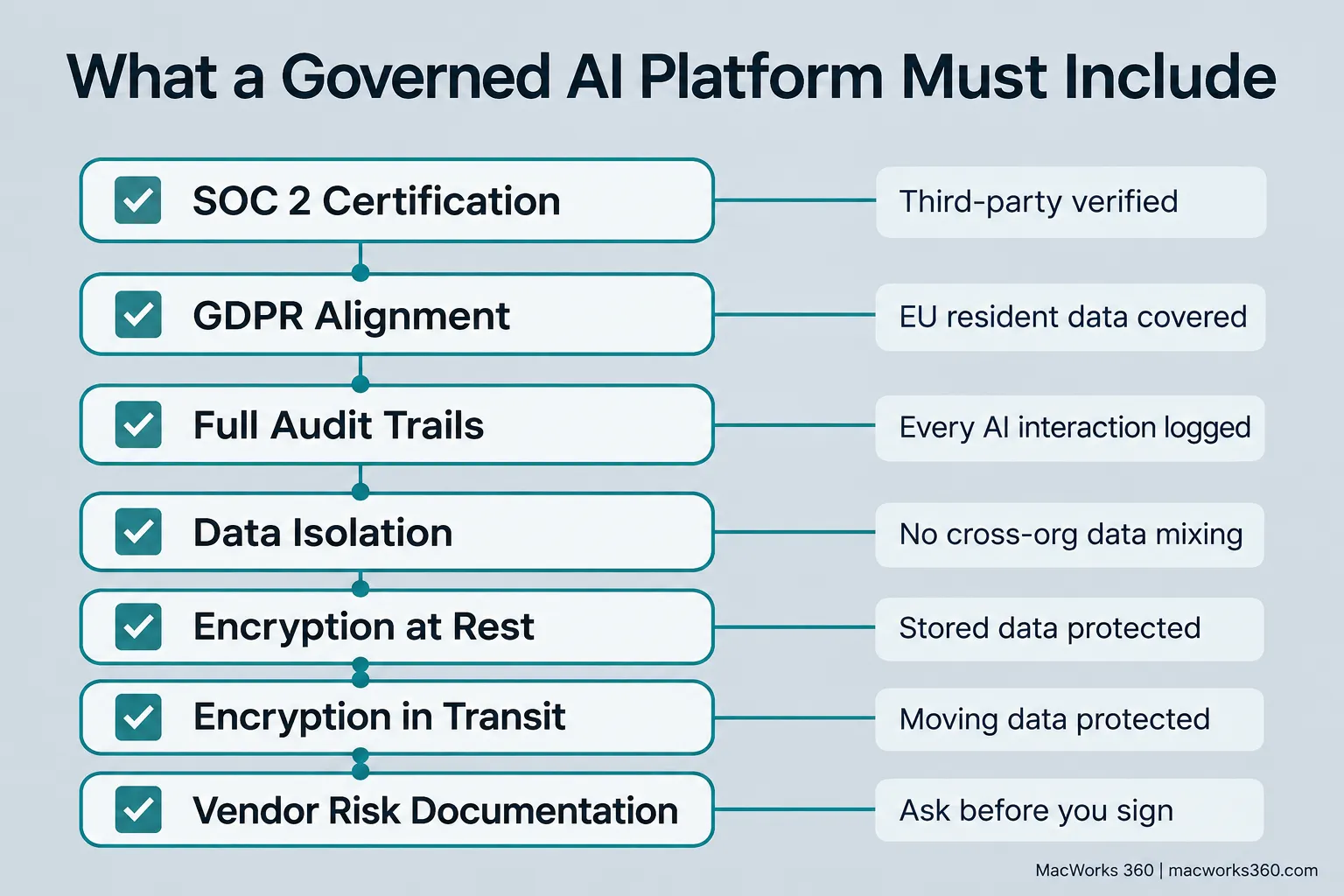
- A governed AI platform should include SOC 2 certification, GDPR-aligned data handling, full audit trails, data isolation, and encryption at rest and in transit.
- “Compliance as a checkbox” creates liability. Compliance built into your AI infrastructure from the start is a defensible position.
- This article is general business guidance, not legal advice. NJ businesses in regulated industries (healthcare, finance, legal, insurance) should consult qualified legal counsel for obligations specific to their sector.
What Is AI Data Compliance in New Jersey?
AI data compliance in New Jersey refers to the set of legal, contractual, and security obligations that govern how businesses collect, process, store, and share data when using AI tools. For NJ businesses, this means satisfying requirements from multiple frameworks simultaneously, not just one law.
The practical definition breaks down into three layers:
- Data security standards: How AI vendors protect the data you feed into their systems (governed primarily by SOC 2).
- Privacy rights: What rights individuals have over their personal data when AI processes it (governed by GDPR for EU residents and the NJDPA for New Jersey consumers).
- AI-specific rules: How AI systems must be designed, documented, and disclosed when used in consequential decisions (governed by the EU AI Act for high-risk applications).
For most NJ small and mid-size businesses, the compliance question is not abstract. It surfaces when a client asks for a vendor security questionnaire, when a cyber insurance carrier requests documentation, or when an employee’s data is processed by an AI hiring tool. These are the moments when not having answers becomes a business problem.
Common mistake: Many NJ business owners assume compliance only applies to large enterprises or companies with EU headquarters. In practice, any business with EU-resident clients, employees, or partners, and any business using AI tools that process personal data, is already operating inside these frameworks whether or not they know it.
New Jersey AI Data Compliance Laws and Regulations: What Applies in 2026
No single “New Jersey AI law” covers everything, but NJ businesses are subject to a layered set of requirements that, taken together, create real obligations.
New Jersey Data Privacy Act (NJDPA)
Signed into law in January 2024 and effective January 15, 2025, the NJDPA grants New Jersey consumers rights over their personal data, including the right to access, correct, delete, and opt out of certain types of processing. Businesses that use AI tools to process consumer data for targeted advertising, profiling, or sale of personal information are directly affected.
Key NJDPA thresholds (verify current applicability with legal counsel, as enforcement guidance may have been updated since publication):
- Applies to businesses that control or process data of 100,000 or more NJ consumers per year, OR
- Derive revenue from selling personal data and process data of 25,000 or more NJ consumers.
GDPR (General Data Protection Regulation)
GDPR is an EU regulation, but it applies extraterritorially. Any NJ business that offers goods or services to EU residents, or monitors their behavior, must comply with GDPR’s data handling requirements. This includes the right to erasure (“right to be forgotten”), which creates a direct conflict with AI tools that use customer data for model training without explicit consent.
EU AI Act (Fully Applicable August 2026)
The EU AI Act classifies AI systems into risk tiers. NJ businesses whose enterprise clients are subject to the EU AI Act may face contractual requirements to demonstrate compliance, even if the NJ business itself is not a direct obligor.
SOC 2 (Contractual and Insurance Standard)
SOC 2 is not a law. It is an auditing standard that has become a de facto requirement in enterprise vendor agreements and cyber insurance policies. If your AI vendor is not SOC 2 certified, many enterprise clients will not sign a contract with you, and some insurers will not cover a breach involving that vendor’s platform.
For a broader look at how data exposure risks have escalated, the 16 billion password exposure incident illustrates why vendor-level security verification matters.
Who Needs AI Compliance in New Jersey?
Any NJ business that uses AI tools and handles personal data from clients, employees, or partners needs to address AI data compliance. The threshold is lower than most business owners expect.
Compliance obligations are most pressing for businesses that:
- Use AI platforms to process client data (CRM integrations, AI-assisted customer service, automated reporting).
- Operate in regulated industries: healthcare (HIPAA), financial services (FINRA, SEC), legal services, or insurance.
- Have enterprise clients who require vendor security documentation as part of their own compliance programs.
- Handle data belonging to EU residents in any capacity.
- Use AI tools for HR functions: resume screening, performance evaluation, or scheduling.
Small businesses are not exempt. The NJDPA’s thresholds are meaningful, but GDPR has no size exemption, and SOC 2 requirements flow through client contracts regardless of company size. A 10-person NJ accounting firm using an AI bookkeeping tool that processes client financial data is operating inside these frameworks.
Choose this path if: Your business is in a regulated industry, handles sensitive client data, or sells to enterprise clients. The cost of a proactive compliance review is significantly lower than the cost of a client-driven audit or a breach response.
AI Data Privacy Compliance in New Jersey: GDPR and the NJDPA Explained
AI data privacy compliance in New Jersey requires satisfying both state-level consumer rights (NJDPA) and, where EU residents are involved, GDPR’s stricter international standard. The two frameworks share common principles but differ in scope and enforcement.
Where they align:
- Both grant individuals rights to access and delete their personal data.
- Both require transparency about how data is used.
- Both restrict automated decision-making that significantly affects individuals without human oversight.
Where they differ:
- GDPR applies to EU residents globally and has no revenue or volume threshold.
- NJDPA applies to NJ consumers and has volume/revenue thresholds (see above).
- GDPR enforcement is handled by EU data protection authorities and can result in fines up to 4% of global annual turnover. NJDPA enforcement is handled by the NJ Attorney General.
The AI-specific complication: Many AI platforms use input data to improve their models. If a user enters client information into an AI tool that trains on that data, the client’s personal information may be retained indefinitely and cannot be deleted on request. This is a direct conflict with both GDPR’s right to erasure and NJDPA’s deletion rights. Before deploying any AI tool, NJ businesses should confirm in writing whether the vendor uses input data for training and whether data deletion requests can be honored.
For practical guidance on protecting sensitive accounts that feed into AI workflows, enabling two-factor authentication is a foundational step that is often overlooked.
What the EU AI Act Means for NJ Businesses in 2026
The EU AI Act became fully applicable in August 2026 and introduces the first comprehensive legal framework specifically governing AI systems. NJ businesses need to understand it for two reasons: direct obligations (if they serve EU clients) and indirect obligations (if their enterprise clients are subject to it and pass requirements down through contracts).
The risk-tier structure:
The EU AI Act classifies AI systems into four tiers:
- Unacceptable risk: Prohibited outright (social scoring by governments, real-time biometric surveillance in public spaces).
- High risk: Subject to strict requirements for documentation, human oversight, and transparency. This is the tier most relevant to NJ SMBs.
- Limited risk: Transparency obligations apply (for example, chatbots must disclose they are AI).
- Minimal risk: No specific obligations beyond existing law.
What counts as high risk for NJ SMBs:
This is where the EU AI Act becomes concrete for small and mid-size businesses. High-risk AI applications include:
- HR and hiring tools: AI that screens resumes, ranks candidates, or evaluates employee performance. A mid-size NJ company using an AI-powered applicant tracking system that automatically filters candidates based on predicted job fit is operating a high-risk AI system under the EU AI Act if any applicants are EU residents.
- Credit and financial assessments: AI that evaluates creditworthiness or sets insurance premiums.
- Legal and compliance tools: AI that assists in legal research, contract review, or regulatory interpretation in ways that affect individual rights.
- Healthcare diagnostics: AI tools used in clinical decision support.
Practical example for NJ businesses: A New Jersey staffing agency uses an AI platform to pre-screen job applications. The platform scores candidates on predicted performance and automatically deprioritizes applications below a threshold score. If any applicants are EU residents, this system qualifies as high-risk under the EU AI Act. The agency would need to document how the AI makes decisions, implement human review of AI-generated rankings, and be able to explain to rejected candidates why they were screened out. If the agency cannot do this, it faces liability both directly and through its enterprise clients’ compliance requirements.
Even if a NJ business is not directly subject to the EU AI Act, enterprise clients in the EU (or US companies with EU operations) will increasingly require their vendors to certify that AI tools used in shared workflows meet EU AI Act standards.
New Jersey AI Compliance vs. Other States: How Does NJ Compare?
New Jersey sits in the middle of the US state AI compliance landscape. It has more consumer data protection than many states but less AI-specific regulation than early movers like Colorado and California.
States with more advanced AI-specific rules (as of August 2026):
- Colorado: The Colorado AI Act (SB 205), effective February 2026, requires developers and deployers of high-risk AI systems to use reasonable care to protect consumers from algorithmic discrimination and to provide disclosures about AI-driven decisions.
- California: Multiple AI-related bills have passed, including requirements for AI training data transparency and restrictions on AI in hiring.
- Illinois: The Artificial Intelligence Video Interview Act has required disclosure and consent for AI-analyzed video interviews since 2020.
New Jersey’s current position:
New Jersey’s NJDPA covers automated decision-making in a limited way but does not yet have a Colorado-style comprehensive AI act. However, NJ businesses serving clients in Colorado, California, or Illinois may be subject to those states’ laws depending on where their clients are located.
The practical implication: NJ businesses should not assume that compliance with NJDPA alone is sufficient. If your client base spans multiple states or includes EU residents, you are operating under multiple simultaneous frameworks. A compliance review should map your actual client geography to the applicable legal standards.
AI Compliance Requirements for NJ Businesses: The Technical Checklist
Meeting AI data compliance requirements in New Jersey means verifying that every AI tool in your stack meets specific technical and contractual standards. The following checklist applies to any NJ business using AI platforms that process client or employee data.
Vendor-level requirements:
- SOC 2 Type II certification (Type II is preferred over Type I because it covers a period of time, not just a point-in-time audit)
- GDPR-compliant data processing agreements (DPAs) available on request
- Written confirmation that input data is not used for model training (or explicit consent obtained from data subjects if it is)
- Data deletion capability: the vendor can honor deletion requests within GDPR’s 30-day window
- Data residency documentation: where is your data stored, and in which jurisdiction
Platform-level requirements:
- Full audit trails: every AI interaction logged, timestamped, and searchable
- Data isolation: your organization’s data is not commingled with other clients’ data
- Encryption at rest and in transit: data is protected whether stored or moving between systems
- Role-based access controls: only authorized users can access sensitive data processed by AI
Internal requirements:
- An inventory of every AI tool in use, including shadow AI (tools employees are using without IT approval)
- A written AI use policy that defines acceptable and unacceptable uses of AI with client data
- A vendor risk assessment process before onboarding new AI tools
- Annual review of all AI tools against current compliance standards
For guidance on building stronger foundational security habits that support compliance readiness, these digital security resolutions cover practical steps that apply directly to AI tool governance.
How Much Does AI Compliance Cost in New Jersey?
AI compliance costs for NJ businesses vary significantly based on company size, industry, and the current state of their AI tooling. There is no single fixed price, but the cost components are predictable.
Disclaimer: The following cost ranges are general estimates based on typical market pricing for compliance services as of 2026. They are not guarantees. Actual costs depend on scope, vendor, and organizational complexity. Consult qualified vendors and legal counsel for accurate quotes.
Cost components for a typical NJ SMB:
- AI compliance review (initial assessment): A managed IT provider or compliance consultant reviewing your current AI tools, data flows, and vendor certifications typically runs from a few hundred dollars for a basic assessment to several thousand for a comprehensive audit with documentation. Costs vary by provider.
- SOC 2-certified AI platform (ongoing): Enterprise-grade AI platforms with SOC 2 certification generally carry higher subscription costs than consumer-grade tools. The premium for a SOC 2-certified platform over an uncertified alternative is real but often justified by the contractual requirements of enterprise clients.
- Legal review (GDPR/NJDPA DPAs): If your business needs attorney review of data processing agreements with AI vendors, expect hourly rates from qualified privacy attorneys. This is a one-time cost per vendor relationship, not an ongoing expense.
- Internal policy development: Writing an AI use policy and vendor assessment process can be done with the help of a managed IT provider. This is typically a project-based cost.
- Ongoing compliance management: Annual reviews, vendor recertification checks, and policy updates are ongoing costs that can be bundled into a managed IT services agreement.
The cost of non-compliance is higher. GDPR fines can reach 4% of global annual turnover for serious violations. A single enterprise client lost due to a failed vendor security questionnaire can dwarf the cost of a compliance review. Cyber insurance premiums are also increasingly tied to documented compliance practices.
How to Get AI Compliance Certified in New Jersey
There is no single “AI compliance certification” issued by a New Jersey state agency. What businesses can do is build a documented, auditable compliance posture that satisfies the standards their clients, insurers, and regulators actually check.
Step-by-step process for NJ businesses:
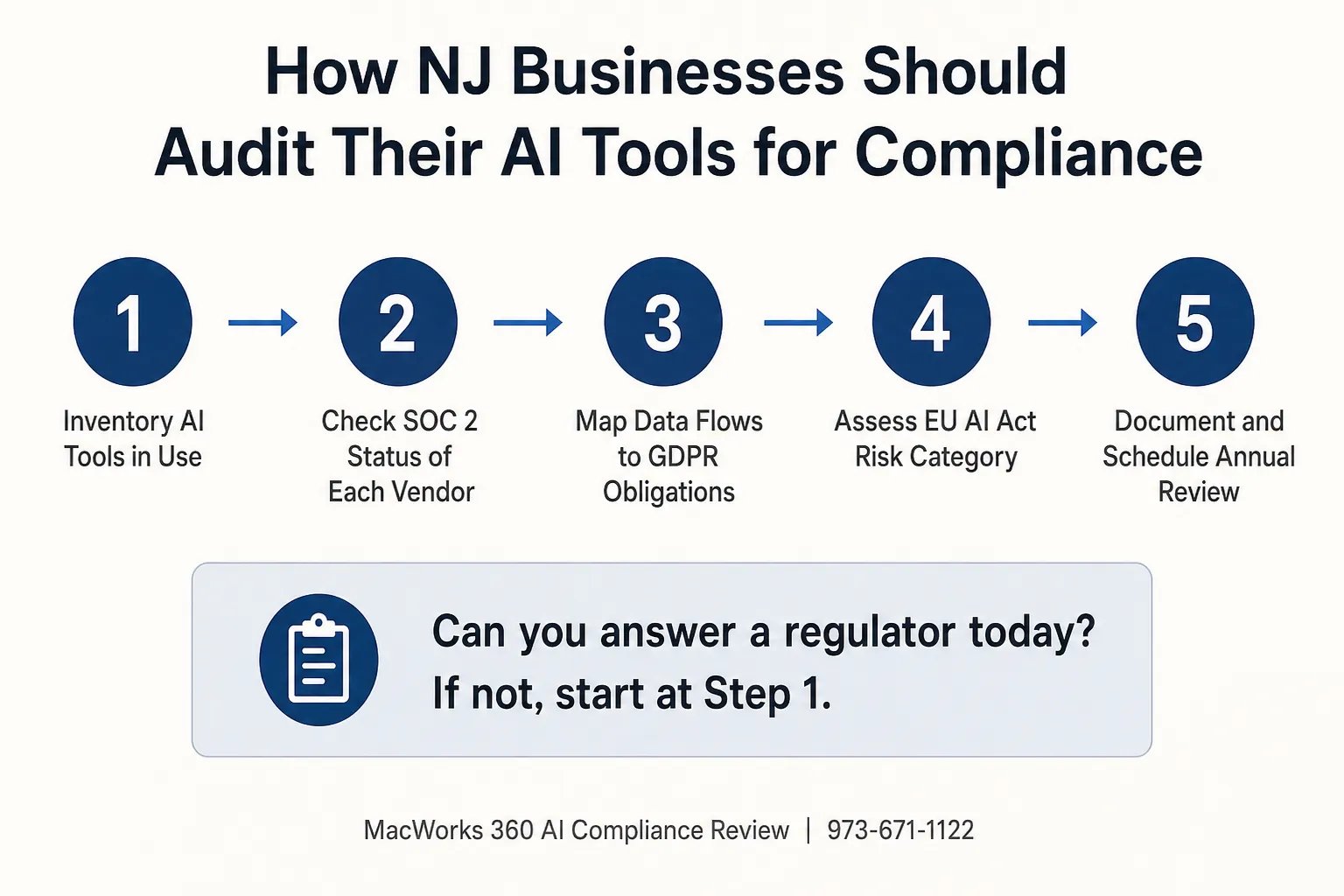
- Inventory all AI tools currently in use, including tools employees are using independently (shadow AI). You cannot manage compliance for tools you do not know exist.
- Check SOC 2 status for each vendor. Request the SOC 2 Type II report directly from the vendor. If they cannot provide one, that is a risk flag.
- Review data processing agreements with each AI vendor. Confirm GDPR compliance, data deletion capabilities, and training data policies.
- Map your client and employee data to applicable legal frameworks. If any data subjects are EU residents, GDPR applies. If you meet NJDPA thresholds, those obligations apply.
- Assess EU AI Act risk categories for each AI tool. If you use AI for HR, finance, or legal functions, determine whether those tools qualify as high-risk.
- Document everything. The ability to produce documentation on demand is the practical definition of compliance readiness.
- Implement an annual review cycle to catch changes in vendor certifications, new AI tools, and evolving regulations.
Who can help: A managed IT provider with AI compliance experience can handle steps 1 through 5 and help build the documentation framework for steps 6 and 7. Legal counsel is needed for step 4 when regulated-industry obligations are involved.
Best AI Compliance Tools and Platforms for New Jersey Companies
The best AI compliance tools for NJ businesses are platforms that build compliance requirements into their infrastructure rather than offering it as an add-on. When evaluating AI platforms, NJ businesses should look for the following verified features before signing a contract.
What to look for in a governed AI platform:
- SOC 2 Type II certification (ask for the current audit report, not just a badge on the website)
- GDPR-compliant data processing agreements available as standard
- No training on customer data (or explicit opt-out available)
- Full audit logs accessible to the customer, not just the vendor
- Data isolation at the tenant level
- Encryption at rest (AES-256 or equivalent) and in transit (TLS 1.2 or higher)
- Documented data residency (where data is stored geographically)
- A clear data deletion process with documented response times
A note on vendor evaluation: MacWorks 360 works with AI platforms that meet these standards as part of its managed AI services for NJ businesses. Any specific platform recommendation should be evaluated against a client’s current vendor stack, industry requirements, and contractual obligations. MacWorks 360 does not endorse specific third-party AI platforms in this article without a current, verified review of that platform’s compliance documentation.
Common mistake: Accepting a vendor’s marketing claims about compliance without requesting actual documentation. “We take security seriously” is not the same as a SOC 2 Type II report. Always ask for the report.
Common AI Compliance Mistakes NJ Businesses Make
The most common AI compliance mistakes among NJ businesses are not technical failures. They are process failures: not knowing what tools are in use, not asking vendors the right questions, and not documenting decisions.
The most frequent mistakes:
- Shadow AI adoption: Employees use consumer AI tools (free chatbot services, AI writing assistants) with client data without IT or management awareness. These tools often have no enterprise data protections and may use input data for training.
- Assuming “cloud” means “compliant”: A tool being hosted in the cloud does not mean it is SOC 2 certified or GDPR compliant. These are separate certifications that must be verified.
- No data processing agreement with AI vendors: Using an AI tool without a signed DPA means you have no contractual protection if the vendor mishandles your data.
- Conflating SOC 2 Type I with Type II: Type I certifies controls at a point in time. Type II certifies that controls operated effectively over a period (typically six to twelve months). Enterprise clients and insurers generally require Type II.
- Not updating the AI tool inventory: New AI features are added to existing software constantly. A tool that was compliant last year may now include AI features that create new data handling questions.
- Skipping the training data question: Not asking whether the AI vendor uses your input data to train their models is one of the most consequential oversights. The answer directly affects GDPR compliance and data confidentiality.
For a practical guide to identifying when vendor communications about security are legitimate versus misleading, this phishing identification guide is a useful companion resource for teams managing AI vendor relationships.
AI Compliance Penalties and Fines: What NJ Businesses Risk
AI compliance failures can result in regulatory fines, contract termination, insurance coverage gaps, and reputational damage. The severity depends on which framework was violated and how.
GDPR penalties:
- Tier 1 violations (less severe): up to 10 million euros or 2% of global annual turnover, whichever is higher.
- Tier 2 violations (more severe, including violations of core data processing principles): up to 20 million euros or 4% of global annual turnover, whichever is higher.
- [Source: EU GDPR, Article 83. Enforcement data is tracked by the GDPR Enforcement Tracker, a publicly available database maintained by CMS Law.]
NJDPA penalties:
- The New Jersey Attorney General enforces the NJDPA. Civil penalties apply for violations. [Verify current penalty amounts with legal counsel, as enforcement guidance may have been updated since publication.]
EU AI Act penalties:
- Violations involving prohibited AI practices: up to 35 million euros or 7% of global annual turnover.
- Violations of high-risk AI obligations: up to 15 million euros or 3% of global annual turnover.
- [Source: EU AI Act, Article 99, as published in the Official Journal of the European Union.]
Non-regulatory consequences:
Beyond fines, the practical business consequences of a compliance failure include: loss of enterprise client contracts (many now include AI compliance representations and warranties), cyber insurance claim denials if a breach involves a non-compliant AI tool, and reputational damage that is difficult to quantify but real.
New Jersey AI Compliance for Healthcare and Other Regulated Industries
Healthcare, financial services, legal, and insurance businesses in New Jersey face the most complex AI compliance obligations because they must satisfy sector-specific regulations on top of GDPR, NJDPA, and the EU AI Act.
Healthcare (HIPAA + AI):
AI tools that process protected health information (PHI) must comply with HIPAA’s Security Rule and Privacy Rule in addition to general data compliance frameworks. This means:
- AI vendors must sign a Business Associate Agreement (BAA) before accessing PHI.
- AI tools cannot use PHI for model training without explicit patient authorization.
- Audit trails must meet HIPAA’s specific logging and retention requirements.
- AI-assisted clinical decision support tools may qualify as high-risk under the EU AI Act, requiring additional documentation and human oversight.
Financial services:
NJ financial services firms using AI for credit decisions, fraud detection, or customer profiling face oversight from FINRA, the SEC, and state banking regulators, in addition to GDPR and NJDPA. AI-driven credit decisions are also subject to the Equal Credit Opportunity Act’s explainability requirements.
Legal services:
Law firms using AI for legal research, contract review, or client communication must address attorney-client privilege in the context of data shared with AI vendors. Standard enterprise AI terms of service are generally not sufficient to protect privileged communications. Firms should obtain written confirmation from vendors about data handling and consider whether client consent is required before using AI with client matter data.
Important scope note: This article is general business guidance and does not constitute legal advice. Businesses in regulated industries should consult qualified legal counsel to identify obligations specific to their sector, jurisdiction, and use case.
New Jersey AI Transparency and Disclosure Rules
AI transparency and disclosure requirements for NJ businesses in 2026 come from multiple sources: the EU AI Act (for high-risk systems), the NJDPA (for automated decision-making), and emerging FTC guidance on AI in consumer-facing applications.
What disclosure is required:
- EU AI Act (high-risk systems): Businesses deploying high-risk AI must inform individuals that they are subject to an AI-driven decision and provide a meaningful explanation of how the decision was made. Human review must be available on request.
- EU AI Act (limited-risk systems): AI chatbots and virtual assistants must disclose that they are AI, not humans.
- NJDPA: Consumers have the right to opt out of automated profiling used for decisions that produce legal or similarly significant effects. Businesses must provide a clear mechanism for this opt-out.
- FTC guidance: The Federal Trade Commission has issued guidance indicating that deceptive use of AI in consumer interactions (including undisclosed AI-generated content in advertising) may constitute an unfair or deceptive practice under Section 5 of the FTC Act.
Practical implication for NJ businesses: If your business uses an AI chatbot on its website, a disclosure that identifies it as AI is both a best practice and, in many contexts, a legal requirement. If your business uses AI to make or influence decisions about clients or employees, a process for human review and explanation must exist.
FAQ: AI Data Compliance in New Jersey
Q: Does GDPR apply to my New Jersey business if I don’t have a European office?
A: Yes. GDPR applies to any business that offers goods or services to EU residents or monitors their behavior, regardless of where the business is located. If any of your clients, employees, or partners are EU residents, GDPR governs how you handle their personal data.
Q: What is the difference between SOC 2 Type I and SOC 2 Type II?
A: SOC 2 Type I certifies that a vendor’s security controls exist and are designed correctly at a specific point in time. SOC 2 Type II certifies that those controls operated effectively over a period of time, typically six to twelve months. Enterprise clients and cyber insurers generally require Type II.
Q: Does the EU AI Act apply to small NJ businesses?
A: Directly, the EU AI Act applies to businesses that place AI systems on the EU market or put them into service within the EU. Indirectly, NJ businesses that serve EU-based enterprise clients may face contractual requirements to comply with EU AI Act standards as a condition of those client relationships.
Q: What is shadow AI and why does it matter for compliance?
A: Shadow AI refers to AI tools that employees use without formal IT or management approval. These tools often lack enterprise data protections and may use input data for model training. Shadow AI is one of the most common sources of unintentional compliance exposure for NJ businesses.
Q: Can I use a free AI tool (like a consumer chatbot) with client data?
A: Generally, no. Consumer-grade AI tools typically do not offer SOC 2 certification, GDPR-compliant data processing agreements, or data isolation. Using them with client data creates compliance exposure and may violate your client contracts.
Q: What is a data processing agreement (DPA) and do I need one with my AI vendor?
A: A DPA is a contract that specifies how a vendor will handle personal data on your behalf. Under GDPR, a DPA is legally required before a vendor processes personal data of EU residents. It should specify what data is processed, for what purpose, how long it is retained, and how deletion requests are handled.
Q: How often should NJ businesses review their AI compliance posture?
A: At minimum, annually. AI platforms update their features frequently, regulations evolve, and new AI tools are adopted by employees without formal review. An annual compliance review should cover the current AI tool inventory, vendor certifications, and any changes in applicable law.
Q: What is the New Jersey Data Privacy Act and how does it relate to AI?
A: The NJDPA, effective January 15, 2025, grants NJ consumers rights over their personal data, including the right to opt out of automated profiling used for significant decisions. Businesses using AI to profile consumers for marketing, credit, or employment decisions need to provide opt-out mechanisms and honor deletion requests.
Q: If my AI vendor is breached, am I liable?
A: Potentially, yes. If you did not conduct reasonable vendor due diligence (including verifying SOC 2 certification and having a signed DPA), regulators and courts may find that you failed to implement appropriate security measures. The existence of a DPA and documented vendor assessment does not eliminate liability but demonstrates reasonable care.
Q: Is this article legal advice?
A: No. This article is general business guidance for NJ business owners evaluating AI tools for compliance risk. It does not constitute legal advice and does not create an attorney-client relationship. Businesses with regulated-industry obligations or specific legal questions should consult qualified legal counsel.
Q: How do I start an AI compliance review for my NJ business?
A: Start with an inventory of every AI tool your business uses, including tools employees have adopted independently. Then check SOC 2 status for each vendor, review data processing agreements, and map your client data to applicable legal frameworks. MacWorks 360 offers AI compliance reviews for NJ businesses. Contact the team at macworks360.com or call 973-671-1122 to schedule a review.
Related Reading
- A practical guide to identifying phishing emails (relevant for teams managing AI vendor communications and access credentials)
- 16 billion passwords exposed: why 2FA matters (foundational security practice for businesses building a compliance posture)
- 5 digital security resolutions that improve your security posture (practical steps that support AI compliance readiness)
- MacWorks 360 AI services (overview of AI support and governance services for NJ businesses)
This article is general business guidance, not legal advice. Regulatory requirements change frequently. NJ businesses in regulated industries (healthcare, financial services, legal, insurance) should consult qualified legal counsel for obligations specific to their sector, jurisdiction, and use case. MacWorks 360 provides managed IT and AI compliance review services for NJ businesses. Contact the team at macworks360.com or 973-671-1122.