Last updated: August 16, 2026
Quick Answer: Most small businesses have no technical controls in place to monitor or restrict how employees use public AI tools at work. That gap creates real legal, compliance, and data security exposure, and you can close it without a large IT budget. AI governance for small business means setting clear policies, deploying the right platform, and knowing exactly what employees share with AI tools and with whom.
Key Takeaways
- Only 17% of organizations have technical controls that can prevent employees from uploading confidential data to public AI tools (source: https://www.ibm.com/think/insights/rising-ai-adoption-creating-shadow-risks).
- Shadow AI, meaning employees using unapproved AI tools without IT oversight, is now one of the top data security risks for small businesses.
- AI governance is not about surveillance. It is about running a defensible, compliant operation.
- Small businesses do not need enterprise-scale infrastructure to implement governance. A clear policy and the right platform are enough to start.
- AI governance and data privacy compliance are related but not the same thing. Both matter, and neither replaces the other.
- Someone on your team should own AI governance, even if it is a part-time responsibility.
- Free templates exist, but you need to adapt them to your specific business context to be useful.
- Review governance policies at least twice a year, or whenever you adopt a major new AI tool.
What Is AI Governance, and Why Does It Matter for Small Businesses?
AI governance is the set of policies, controls, and accountability structures that determine how an organization uses artificial intelligence tools. For small businesses, it matters because AI adoption is already happening, whether leadership has approved it or not.
When employees use public AI tools like ChatGPT to draft contracts, summarize client data, or troubleshoot internal processes, that data leaves your environment. Without governance, there is no record of what was shared, no way to demonstrate compliance during an audit, and no mechanism to catch mistakes before they become incidents. AI governance for small business is not a luxury feature reserved for large enterprises. It is a basic operational safeguard.
Common mistake: Many small business owners assume that because they have not officially “adopted AI,” they have no AI risk. The risk comes from unofficial adoption, not official policy.
How Is AI Governance Different for Small Businesses Versus Large Companies?
Large enterprises typically have dedicated AI ethics boards, legal review cycles, and IT teams that can enforce technical controls at scale. Small businesses have none of that, and they should not try to replicate it.
For a company with 10 to 75 employees, AI governance looks more like:
- A documented list of approved AI tools and prohibited use cases
- A single point of accountability (an office manager, IT lead, or operations director)
- A lightweight platform that logs AI interactions and provides usage analytics
- A one-page policy that employees actually read and sign
The goal is not compliance theater. It is genuine visibility into how AI is being used, with enough structure to respond quickly if something goes wrong.
Choose this approach if: Your team is already using AI informally and you need to get ahead of the risk without overhauling your entire IT stack.
What Are the Main Risks of Not Having AI Governance?
The most immediate risk is data leakage. When an employee pastes a client contract, financial record, or internal strategy document into a public AI tool, that data is processed by a third-party system outside your control. Depending on the tool and its terms of service, it may use that data to train its model.
Beyond data leakage, the risks include:
- No audit trail. If a client, regulator, or attorney asks how a particular piece of information was handled, you have no record.
- Compliance exposure. Industries like healthcare, finance, and legal services have specific data handling requirements. Unmonitored AI use can create violations without anyone realizing it.
- Operational errors. AI tools produce incorrect outputs. Without oversight, those errors can move from a chatbot response into a client deliverable or a business decision.
- Reputational damage. A single high-profile data incident tied to AI misuse can cost more than years of governance investment.
For a deeper look at how data exposure happens across digital tools, the MacWorks 360 guide to identifying phishing emails covers related threat patterns worth understanding alongside AI risk.
Does Law require AI Governance for Small Businesses?
No single federal law in the United States mandates AI governance for small businesses as of mid-2026. However, existing regulations create indirect obligations that AI governance helps satisfy.
If your business handles protected health information, HIPAA obligations extend to how AI tools process patient data. If you operate in financial services, SEC and FINRA guidance increasingly addresses AI-generated content and recordkeeping. State-level privacy laws, including those modeled on the CCPA, create data-handling duties that public AI tool use can easily violate.
The practical answer: AI governance may not be explicitly required by name, but the underlying obligations it addresses almost certainly apply to your business. Governance is how you demonstrate that you are meeting those obligations.
Edge case: Even if your industry has no specific AI regulation today, regulators are moving quickly. Businesses that build governance frameworks now will face far less disruption when formal requirements arrive.
Do I Need AI Governance If I’m Using Off-the-Shelf AI Tools?
Yes. Off-the-shelf AI tools pose the biggest risk for most small businesses.
Enterprise-built custom AI systems typically include data processing agreements, access controls, and audit logging. Consumer-grade tools like free tiers of public chatbots often do not. When an employee uses a personal or free-tier account on a public AI platform, your organization has no visibility, no contractual protection, and no way to enforce data handling standards.
The question is not whether the tool is sophisticated. The question is whether your organization controls how it is used and what data goes into it.
What Does AI Governance Actually Look Like in Practice for a Small Business?
Small businesses have more options than they did even 18 months ago. The category has expanded significantly as demand from mid-market and SMB buyers has grown.
Platforms worth evaluating fall into a few categories:
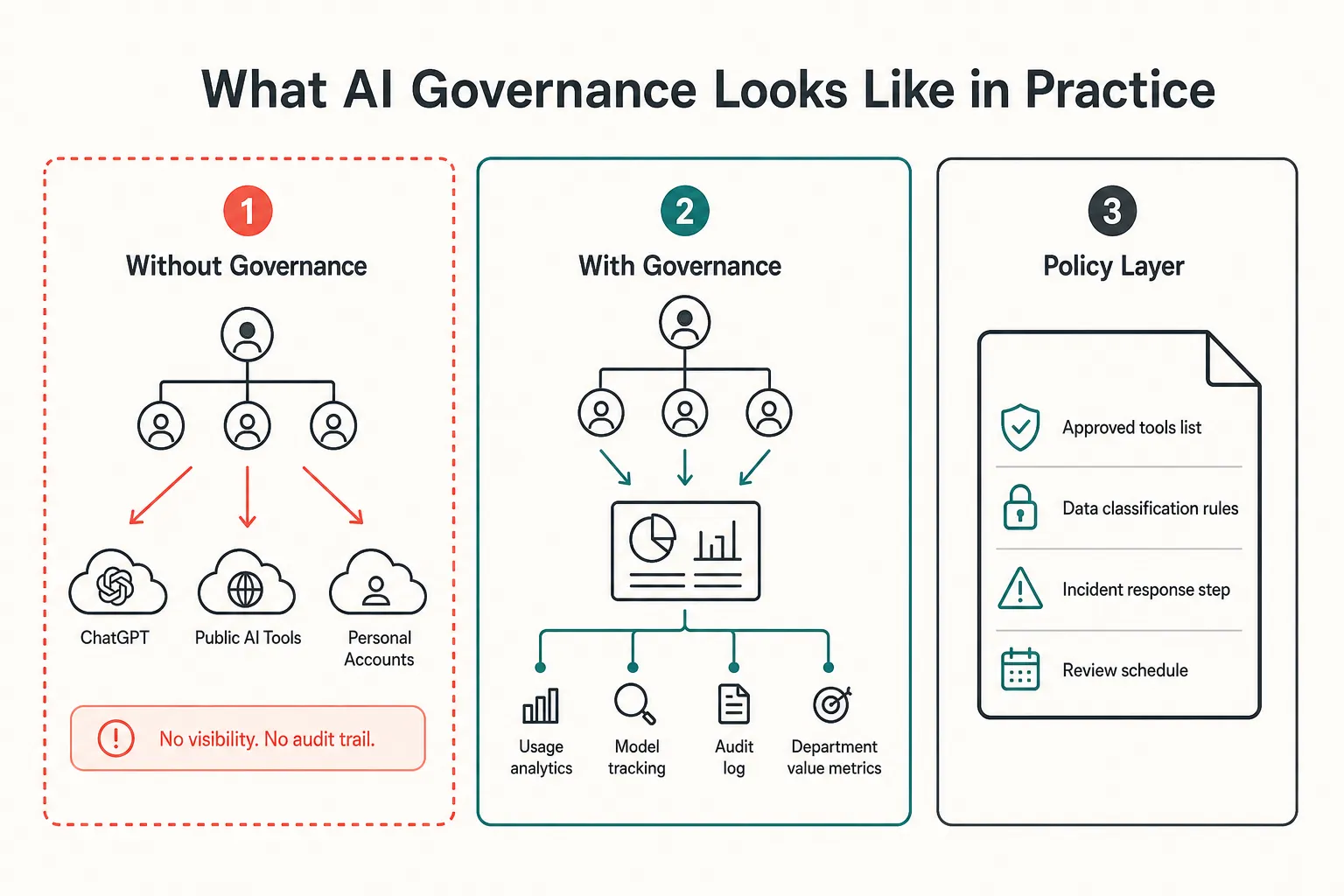
- An approved tools list: Three or four AI tools that IT has reviewed and approved, with enterprise data agreements in place.
- A usage policy: A one-to-two page document that defines what types of data can and cannot be entered into AI tools, signed by all employees.
- A governance platform: A tool like Goodweek or a comparable solution that gives administrators a dashboard showing which tools are being used, by which teams, and how frequently.
- An audit log: A searchable record of AI interactions that can be produced during a compliance review or legal matter.
- A named owner: One person responsible for reviewing the policy annually and fielding questions from staff.
That is it. No dedicated AI ethics board. No six-figure consulting engagement. Just structure, visibility, and accountability.
What AI Governance Tools Are Available for Small Businesses?
Small businesses have more options than they did even 18 months ago. The category has expanded significantly as demand from mid-market and SMB buyers has grown.
Platforms worth evaluating fall into a few categories:
- Governed AI management platforms (such as Goodweek): Provide a full AI workspace for employees alongside administrator dashboards, governance controls, model restrictions, usage visibility by team or individual, and full audit logs on every interaction. SOC 2 certified and GDPR compliant, these platforms are purpose-built to eliminate shadow AI, prevent data leakage, and give businesses centralized control — without sacrificing productivity.
- Enterprise AI access layers: Tools that sit between employees and public AI models, enforcing data loss prevention rules and logging interactions.
- Policy management tools: Lightweight platforms for distributing, collecting signatures on, and tracking acknowledgment of AI use policies.
For most small businesses, visibility and control go hand in hand. Start with a platform that shows you what is actually happening and lets you enforce the right guardrails — before shadow AI becomes a bigger problem.
How Much Does It Cost to Implement AI Governance for a Small Business?
For a business with 10 to 75 employees, a functional AI governance setup does not require a large budget. The cost breaks down roughly as follows:
- Policy development: Can be done internally using available templates, or with a few hours of consulting support. Cost ranges from nothing to a few hundred dollars.
- Governance platform: Purpose-built SMB tools typically cost a few hundred dollars per month at this employee count. Enterprise-tier tools with full data loss prevention capabilities cost more.
- IT consulting and setup: If you are working with a managed services provider, initial configuration and policy review can often be bundled into an existing engagement.
The more relevant cost comparison is the cost of not having governance: a single data incident, regulatory fine, or client contract dispute will almost always exceed what a year of governance investment would have cost.
How Do I Start an AI Governance Framework With Limited Resources?
Start with an audit, not a policy. Before writing rules, find out what is actually happening.
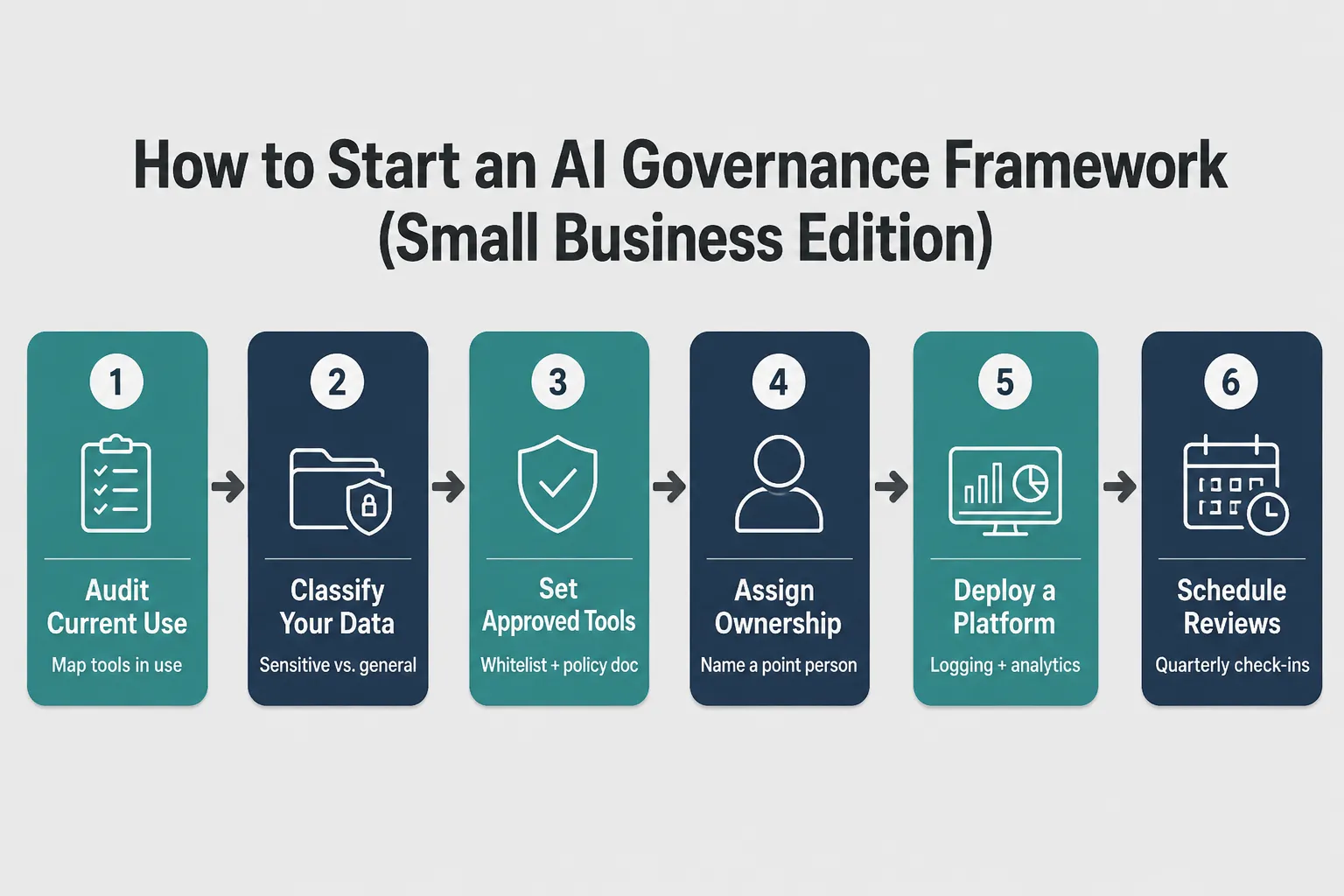
Step 1: Map current AI use. Ask your team directly, or use a platform that can surface usage data. Find out which tools are being used, for what tasks, and with what types of data.
Step 2: Classify your data. Identify what categories of information your business handles: client data, financial records, employee information, proprietary processes. Determine which categories should never enter a public AI tool.
Step 3: Build an approved tools list. Based on your audit, decide which tools are acceptable with proper data agreements and which are not. Document this clearly.
Step 4: Write a simple policy—one to two pages. Approved tools, prohibited data types, what to do if something goes wrong. Have employees sign it.
Step 5: Deploy a monitoring platform. Choose a tool that gives you ongoing visibility into AI usage across your organization.
Step 6: Assign ownership and set a review schedule. Name one person responsible. Put a calendar reminder for a policy review every six months.
This process can be completed in a few weeks with the right support. MacWorks 360 helps New Jersey businesses work through exactly this sequence. A free consultation is the fastest way to identify gaps before they become problems.
Who Should Be Responsible for AI Governance on a Small Team?
In a small business, AI governance does not need a dedicated role. It needs a named owner.
The right person is typically whoever currently owns IT policy, data security, or operations. In a 15-person firm, that might be the office manager, the COO, or an external managed services provider. What matters is that one person is clearly accountable for keeping the approved tools list current, distributing policy updates, and fielding staff questions.
If your business works with an IT partner like MacWorks 360, that partner can serve as the governance resource, handling platform setup, policy templates, and periodic reviews without requiring internal headcount.
Can I Use AI Governance Templates, or Do I Need Custom Policies?
Templates are a legitimate starting point, and several credible sources publish them, including NIST and industry associations. The problem is that generic templates are not enforceable as written. You need to adapt them to reflect your specific tools, data types, industry obligations, and team structure.
A template that says “do not share confidential information with AI tools” isn’t actionable unless your employees know exactly what counts as confidential in your context.
Use templates to save time on structure and language. Then customize the substance to match your actual business. If you are unsure how to do that, a single consulting session can close the gap quickly.
What Are Common Mistakes Small Businesses Make With AI Governance?
The most common mistake is waiting. Business owners often assume AI governance is something to address after they formally adopt AI tools. By then, informal adoption is already well underway, and the risk has been accumulating for months.
Other frequent mistakes include:
- Treating policy as a one-time event. AI tools change rapidly. A policy written in early 2025 may not address tools that are standard by late 2026.
- Focusing only on approved tools while ignoring personal device use. Employees using personal phones or home computers to access AI tools fall outside most corporate monitoring setups.
- Conflating AI governance with general cybersecurity. They overlap, but AI governance addresses specific risks around data inputs, model outputs, and accountability that standard security frameworks do not fully cover. Reviewing your digital security fundamentals is a good complement, but it does not substitute for AI-specific governance.
- Assuming employees will self-police. The 83% figure cited at the top of this article exists precisely because the honor system does not work at scale.
What Is the Difference Between AI Governance and Data Privacy Compliance?
Data privacy compliance (GDPR, CCPA, HIPAA) governs how personal data is collected, stored, and processed. AI governance governs how AI tools are used, what data enters them, what outputs are trusted, and who is accountable for AI-related decisions.
The two frameworks overlap significantly. An employee uploading customer records to a public AI tool creates both an AI governance failure and a potential data privacy violation. But they are not the same thing, and satisfying one does not automatically satisfy the other.
Think of data privacy compliance as the floor and AI governance as the structure you build on top of it. Both are necessary, and neither replaces the other.
For businesses that have experienced data exposure in other contexts, the MacWorks 360 overview of the 16 billion passwords breach illustrates how quickly unmanaged data risk escalates.
How Often Should We Review Our AI Governance Policies?
At minimum, twice per year. In practice, any of the following events should also trigger an immediate review:
- A major new AI tool is adopted by your team (approved or not)
- A significant update to an existing approved tool changes how data is handled
- A regulatory change affects your industry’s data obligations
- An employee raises a concern or a near-miss incident occurs
The AI tool landscape is moving fast enough that a policy written 12 months ago may already have gaps. Build the review cadence into your calendar now, before it becomes reactive.
Our Take
At MacWorks 360, when we do an AI readiness review with a client, the first thing we look for isn’t which tools they’re using. It’s whether anyone actually knows what’s being used, by whom, and for what purpose. Nine times out of ten, the answer surprises the business owner.
Getting visibility doesn’t require a massive infrastructure overhaul. It requires the right platform and a clear policy. We can help with both.
Not sure what your team is currently using? Start with a free consultation. We’ll help you map the landscape and identify the gaps before they become problems.
macworks360.com | 973-671-1122
Frequently Asked Questions
What is shadow AI?
Shadow AI refers to employees using AI tools that IT or management has not approved or reviewed. It mirrors the shadow IT problem of the 2010s but moves faster and carries higher data-security stakes because AI tools process and may retain the content users submit.
Is ChatGPT safe to use for business tasks?
It depends on the account type, the data involved, and your industry obligations. Free-tier consumer accounts typically do not include enterprise data protection agreements. Business and enterprise accounts offer stronger protections but still require a governance policy for responsible use.
What is the first step in building an AI governance framework?
Audit what your team is already using. You cannot govern what you cannot see. Start by mapping current AI tool usage across your organization before writing any policies.
Does AI governance apply to small businesses with fewer than 20 employees?
Yes. The risks of unmonitored AI use scale with the sensitivity of the data involved, not business size. A five-person law firm or medical practice has significant exposure regardless of headcount.
How is AI governance different from cybersecurity?
Cybersecurity focuses on protecting systems and data from external threats. AI governance focuses on controlling how internal users interact with AI tools, what data they share, and how they use AI outputs in business decisions. Both matter, and they address different risk surfaces.
Can my managed IT provider handle AI governance for me?
Yes, in most cases. A managed services provider can handle platform selection, policy templates, employee training, and ongoing monitoring. This is the most practical option for small businesses without internal IT staff.
What happens if an employee violates an AI use policy?
That depends on the consequences you define in your policy, which is one reason a written policy matters. Without a documented policy, there is no basis for a consistent response. With one, you can address violations fairly and defensibly.
Do I need to tell employees that AI usage is being monitored?
In most jurisdictions, yes. Transparency about monitoring is both a legal best practice and an ethical one. The goal of AI governance is not to catch employees doing something wrong. It is to protect the business and give employees clear guidance on acceptable use.
What is an AI audit log and why does it matter?
An audit log is a searchable record of AI interactions within your organization. It matters because it creates a paper trail. If a client dispute, regulatory inquiry, or legal matter arises, an audit log lets you demonstrate what was shared with AI tools, when, and by whom.
How long does it take to implement basic AI governance?
With the right support, a small business can implement a functional governance framework within two to four weeks. That includes an initial audit, a written policy, platform deployment, and employee acknowledgment.
Sources and Notes
- Governed AI management platforms (such as Goodweek): Features include administrator dashboards, governance controls, model restrictions, usage visibility by team or individual, and full audit logs. SOC 2 certified and GDPR compliant. Eliminates shadow AI and prevents data leakage. See goodweek.com.
- NIST AI Risk Management Framework: National Institute of Standards and Technology, 2023. Available at nist.gov.
- All other claims in this article reflect MacWorks 360 advisory experience and publicly available industry context as of August 2026.