Last updated: August 16, 2026
Quick Answer: An AI vendor data training policy is the contractual clause that determines whether the vendor can use your business conversations, documents, and inputs to improve its AI models. For small and mid-size businesses in law, finance, healthcare, and HR, this clause is the single most important line in any AI vendor agreement. If it does not explicitly prohibit training on your data, your confidential client information, internal processes, and competitive strategy may become permanently embedded in a model you no longer control.
Key Takeaways
- Free and consumer-tier AI tools almost universally reserve the right to train on your data. Enterprise platforms with proper governance do not.
- Once your data is used to train a model, you can’t remove it. No delete function exists for embedded model weights.
- The Samsung data leak incident (2023) is a documented example of proprietary business data entering an AI system without adequate controls.
- Regulated industries (law, finance, healthcare, HR) face professional and legal obligations around confidentiality that consumer AI tools routinely violate by default.
- A compliant enterprise AI vendor will offer contractually guaranteed data isolation, zero model training on client data, and clear answers on jurisdiction and cancellation.
- GDPR and emerging AI governance frameworks restrict how personal data can be used in model training, with real enforcement consequences.
- The five questions in this article form a practical pre-signature checklist for evaluating any AI vendor.
- “Data isolation” and “no training” are not the same thing. A vendor can store your data separately and still train on it.
- If a vendor cannot answer your data policy questions clearly and in writing, that is itself a disqualifying answer.
- MacWorks 360 helps SMB clients evaluate AI tools for safety, compliance, and operational fit before signing any contract.
What Is an AI Vendor Data Training Policy?
An AI vendor data training policy is the section of a vendor’s terms of service (or enterprise data processing agreement) that defines whether, and how, the vendor may use your inputs to train, fine-tune, or improve its AI models. It is distinct from a general privacy policy, which covers how data is stored and accessed. The training policy specifically addresses whether your data becomes part of the model itself.
For business users, this distinction matters enormously. A vendor may store your data securely and still use it to improve model performance. These are two separate commitments, and both need to be addressed explicitly in writing.
Key terms to look for in any AI vendor data training policy:
- “We do not use your data to train or fine-tune our models.”
- “Your data is processed solely to provide the service and is not used for model improvement.”
- “Enterprise customer data is excluded from training datasets.”
If none of these phrases appear, and the policy only addresses storage or access, the training question is unanswered and should be treated as a risk.
How Do AI Companies Use Your Data to Train Their Models?
AI companies use training data to adjust the internal parameters (called weights) of their models, making responses more accurate, contextually appropriate, or commercially useful. When a user interacts with an AI tool, those conversations can be logged, reviewed, and fed into future training cycles. As a result, the model “learns” from real-world usage patterns.
This process is standard and, in many contexts, legitimate. The problem for business users is that it means your specific inputs, including client names, financial figures, legal strategies, HR notes, and proprietary processes, can become part of a shared model that other users interact with. The information is not stored as a retrievable file. It is diffused into the model’s behavior in ways that are difficult to trace or reverse.
This is why the Samsung incident in 2023 became a widely cited cautionary example. Samsung engineers pasted proprietary chip design details into ChatGPT for assistance with code review. That data may have been incorporated into model training before Samsung identified the exposure. The company subsequently banned generative AI tools on company devices. The lesson is not that AI tools are inherently dangerous. It is that using the wrong AI tool for the wrong context, without reviewing the data training policy first, creates a risk that cannot be undone after the fact.
Are AI Training Policies Different for Free vs. Paid Users?
Yes, and the difference is significant. Free and consumer-tier AI tools almost universally include data training rights in their default terms. That’s how the product is funded and improved. Users get a capable tool at no cost, and the vendor gets training signals from real-world usage. For personal tasks, this trade-off is often acceptable.
For business use, it is not. The moment an employee pastes a client contract, a financial projection, or a patient record into a free AI tool, that data may enter a training pipeline with no business-grade controls, contractual protections, or mechanism for removal.
Paid consumer tiers sometimes offer opt-out options, but these vary by vendor and are not always the default. Enterprise plans, by contrast, are specifically designed to exclude customer data from training. This is a core selling point of enterprise AI platforms, and you should verify it in the contract, not assume it based on price tier.
The practical rule: if a team member uses an AI tool on a free or personal account for work tasks, the business has no data-training protections, regardless of what the enterprise plan covers.
What Happens to Your Data When You Use ChatGPT or Claude?
The answer depends on the version and account type in use. OpenAI’s ChatGPT and Anthropic’s Claude both offer enterprise and API tiers that contractually exclude customer data from model training. Their consumer and free tiers have historically included data use rights for training, with varying opt-out mechanisms.
As of mid-2026, both vendors have expanded their enterprise data protection commitments in response to regulatory pressure and enterprise demand. However, the specific terms change over time, and the only reliable way to know what applies to your organization is to read the current data processing agreement for your specific plan.
What both platforms share, like most large AI providers, is this: the consumer experience and the enterprise experience operate under fundamentally different data governance rules. A business that allows employees to use personal or free accounts for work tasks is not covered by the enterprise agreement, even if the company also holds an enterprise license.
Reviewing your current AI tool setup against your vendor agreements is a practical first step before any formal evaluation process.
What Is the Difference Between Data Training and Data Storage?
Data storage refers to where your inputs are held, how long they’re kept, and who can access them. Data training refers to whether those inputs are used to modify the model’s behavior and parameters. These are separate processes with separate risks.
A vendor can offer highly secure, isolated data storage and still use your data for training. Conversely, a vendor can exclude your data from training entirely while storing it in a shared cloud environment. Evaluate both dimensions independently.
For regulated industries, data storage raises compliance questions around jurisdiction, retention periods, and access controls. Data training raises a different set of concerns: competitive exposure, confidentiality obligations, and the irreversibility of model embedding. Neither question answers the other.
When evaluating an AI vendor, ask both questions explicitly:
- “Where is our data stored, and for how long?”
- “Is our data used in any way to train, fine-tune, or improve your models or any third-party models?”
A vendor that conflates these two questions in their answer, or that answers only one when asked both, is worth scrutinizing further.
Which AI Vendors Don’t Use Customer Data for Training?
Several enterprise AI platforms make explicit contractual commitments to exclude customer data from model training. Goodweek, for example, operates with what it describes as 100% data isolation, which means:
- Customer data never touches another customer’s environment.
- Customer data is never used to train or fine-tune any model.
- Customer data is never accessible outside the customer’s organization.
This is not marketing language. It is a contractual commitment, and it represents the standard that any AI vendor serving regulated industries should be able to meet.
Other enterprise platforms, including Microsoft’s Azure OpenAI Service and certain configurations of Google Cloud’s Vertex AI, offer similar commitments at the enterprise tier. The keyword in every case is “contractual.” A vendor’s blog post or FAQ is not a data processing agreement. The commitment needs to appear in the signed contract.
Exploring AI tools built for business governance is a useful starting point, but vendor selection should always end with a contract review.
Can You Opt Out of AI Training Data Collection?
Some vendors offer opt-out mechanisms, but availability, ease, and reliability vary widely. For enterprise customers, the opt-out is typically built into the data processing agreement rather than a user-level toggle. For consumer users, opt-out options may exist but are not always the default, and may not apply retroactively to data already submitted.
For businesses in regulated industries, relying on an opt-out mechanism is a weaker position than choosing a vendor whose default policy excludes training entirely. Opt-outs can be missed, misconfigured, or subject to policy changes. A vendor whose baseline contract prohibits training on customer data requires no ongoing management of that risk.
If a vendor offers an opt-out rather than a default exclusion, ask: “What is your policy for data submitted before the opt-out was activated?” If the answer is unclear, that data may already be in a training pipeline.
Do AI Vendors Sell Training Data to Other Companies?
Reputable enterprise AI vendors do not sell customer data to third parties for training purposes. However, some vendors use third-party model providers (such as OpenAI or Anthropic) as the underlying engine for their product, and the data processing agreement may pass data through to those providers. In that case, the relevant policy is the sub-processor’s policy, not just the primary vendor’s.
This is a common gap in vendor evaluations. A business may review the terms of a productivity tool that uses AI features, confirm that the tool’s policy prohibits training, and miss that the underlying model provider has different terms.
The question to ask: “Do any third-party sub-processors receive our data, and if so, what are their data training policies?”
This is also relevant to digital security practices more broadly. Data exposure through third-party processors is a documented vector for business risk, and AI tools are no exception.
What Are the Risks of AI Vendors Using Your Data for Training?
The risks fall into three categories: competitive exposure, compliance violations, and irreversibility.
Competitive exposure: If your pricing strategy, client list, internal processes, or product roadmap enters a shared training dataset, that information can influence model outputs for other users. The mechanism is indirect and difficult to prove, but the risk is real and has been documented in research on model memorization.
Compliance violations: In law, finance, healthcare, and HR, confidentiality is a professional and legal obligation. Using an AI tool that trains on client data may breach attorney-client privilege, violate HIPAA, breach financial services confidentiality, or fail to protect HR data, depending on the industry and jurisdiction. These are not theoretical risks. Regulators in multiple jurisdictions have begun issuing guidance specifically addressing AI tool use in regulated professions.
Irreversibility: This risk distinguishes AI training from other data exposure events. If a file is leaked, it can be identified and, in some cases, remediated. If data is embedded in model weights, there is no equivalent remediation path. The information becomes part of the model’s behavior in a diffuse, untraceable way. There is no delete button.
What Do GDPR Rules Say About AI Vendor Data Training?
GDPR places significant restrictions on how personal data can be used for AI model training, and these rules apply to any business operating in or serving customers in the European Union. The core principle is purpose limitation: data collected for one purpose (providing a service) cannot be repurposed for a different use (training a model) without a separate legal basis.
For AI vendors processing EU personal data, this means training on customer inputs typically requires either explicit consent or a legitimate interest assessment that can withstand regulatory scrutiny. Several EU data protection authorities have already issued enforcement actions and guidance specifically targeting AI training practices.
For businesses in the EU or with EU customers, the practical implication is straightforward: an AI vendor that trains on your data without a clear legal basis is exposing your business to GDPR liability, not just their own. The data controller (your business) shares responsibility for how data is processed.
The questions to ask a vendor from a GDPR perspective:
- “What is your legal basis for any processing of our data beyond service delivery?”
- “Are you a data processor or a data controller under GDPR for our data?”
- “Do you have a Data Processing Agreement (DPA) available, and does it address model training?”
Staying current on digital security and compliance is an ongoing practice, not a one-time review, and AI vendor governance is now a core part of that discipline.
Why Do Some AI Companies Train on Public Data, and Does That Affect You?
Most large AI models are initially trained on publicly available data: web pages, books, code repositories, and other open sources. This is standard practice and, in most jurisdictions, legally permissible for genuinely public data. The concern for business users is not training on public data. It is using private, proprietary, or confidential business data submitted through a commercial AI tool.
The distinction matters because some vendors conflate these two things in their marketing. “We train on publicly available data” does not mean “we do not train on your data.” Both statements can be true simultaneously. A vendor can train the base model on public data and still use customer inputs to fine-tune or improve it over time.
When a vendor says, “we only use public data for training,” ask: “Does that commitment extend to all customer inputs, including API calls, enterprise user conversations, and document uploads?”
How Do You Know If Your Data Is Being Used for AI Training?
Short answer: you cannot know after the fact, which is why the contract review must happen before you start using the tool. Once you submit data to an AI system, no audit trail shows whether it entered a training pipeline. The only reliable protection is a contractual prohibition that prevents it from happening in the first place.
Practical steps to take before deploying any AI tool in a business context:
- Request the vendor’s data processing agreement (DPA) and read the training data clause specifically.
- Ask the vendor directly, in writing, whether it uses customer data for training, fine-tuning, or model improvement.
- Confirm whether the answer applies to all data types (conversations, uploaded documents, API inputs).
- Verify whether third-party sub-processors are involved and request their policies as well.
- Check whether the commitment is contractual (in the DPA) or only stated in a FAQ or blog post. Only the DPA is enforceable.
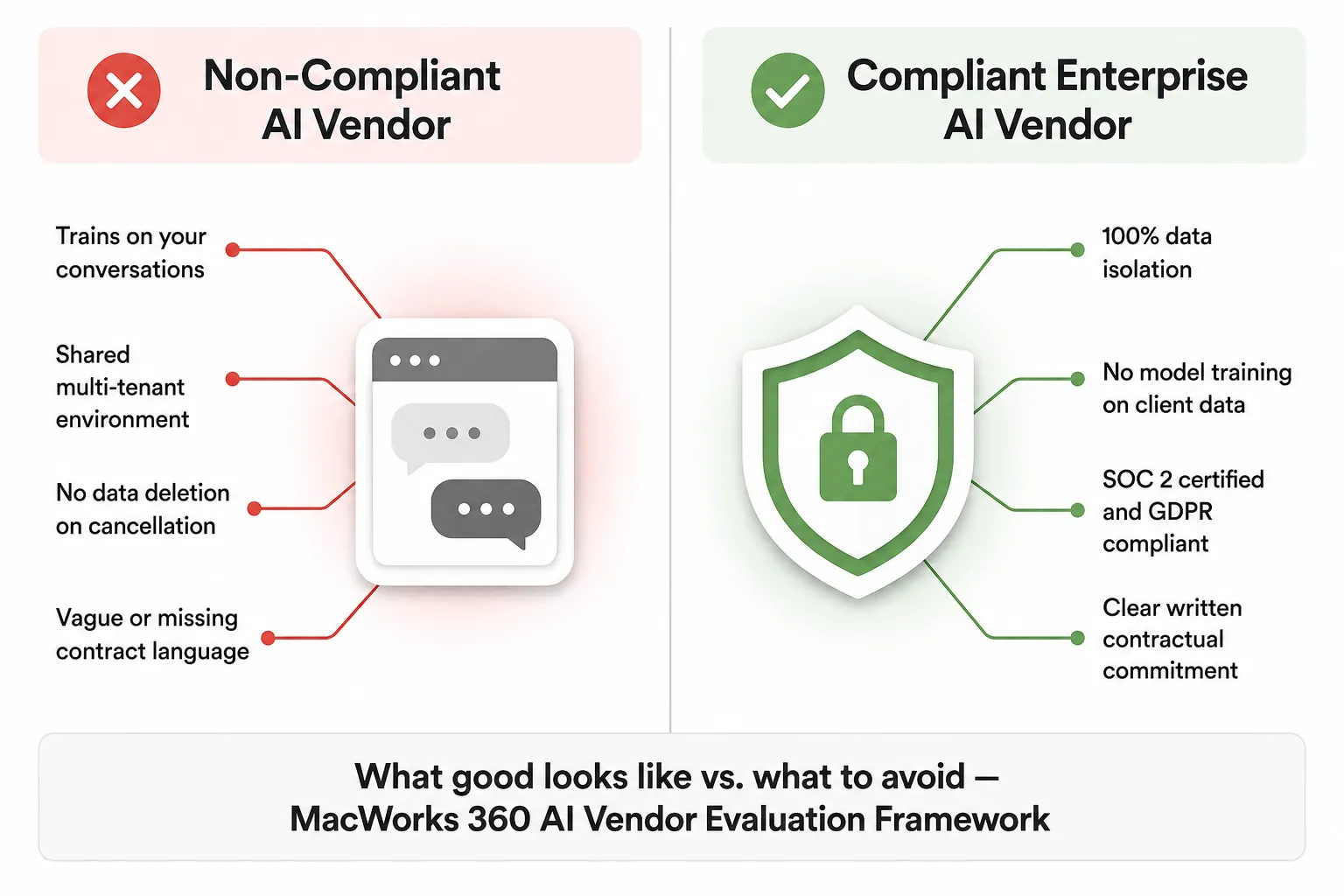
What Does a Compliant AI Vendor Look Like vs. a Non-Compliant One?
The difference is concrete and verifiable. Here is a direct comparison:
| Evaluation Criteria | Non-Compliant Vendor | Compliant Enterprise Vendor |
|---|---|---|
| Model training policy | Trains on customer data by default | Contractually prohibits training on customer data |
| Data environment | Shared multi-tenant infrastructure | Isolated customer environment |
| Response to direct questions | Vague, redirects to FAQ | Clear, written, contractual |
| Compliance certifications | None stated or unverifiable | SOC 2 certified, GDPR-compliant DPA available |
| Data on cancellation | Unclear retention policy | Defined deletion or return process |
A vendor that cannot fill the right column of this table is not ready for regulated industry use, no matter how capable its AI features are.
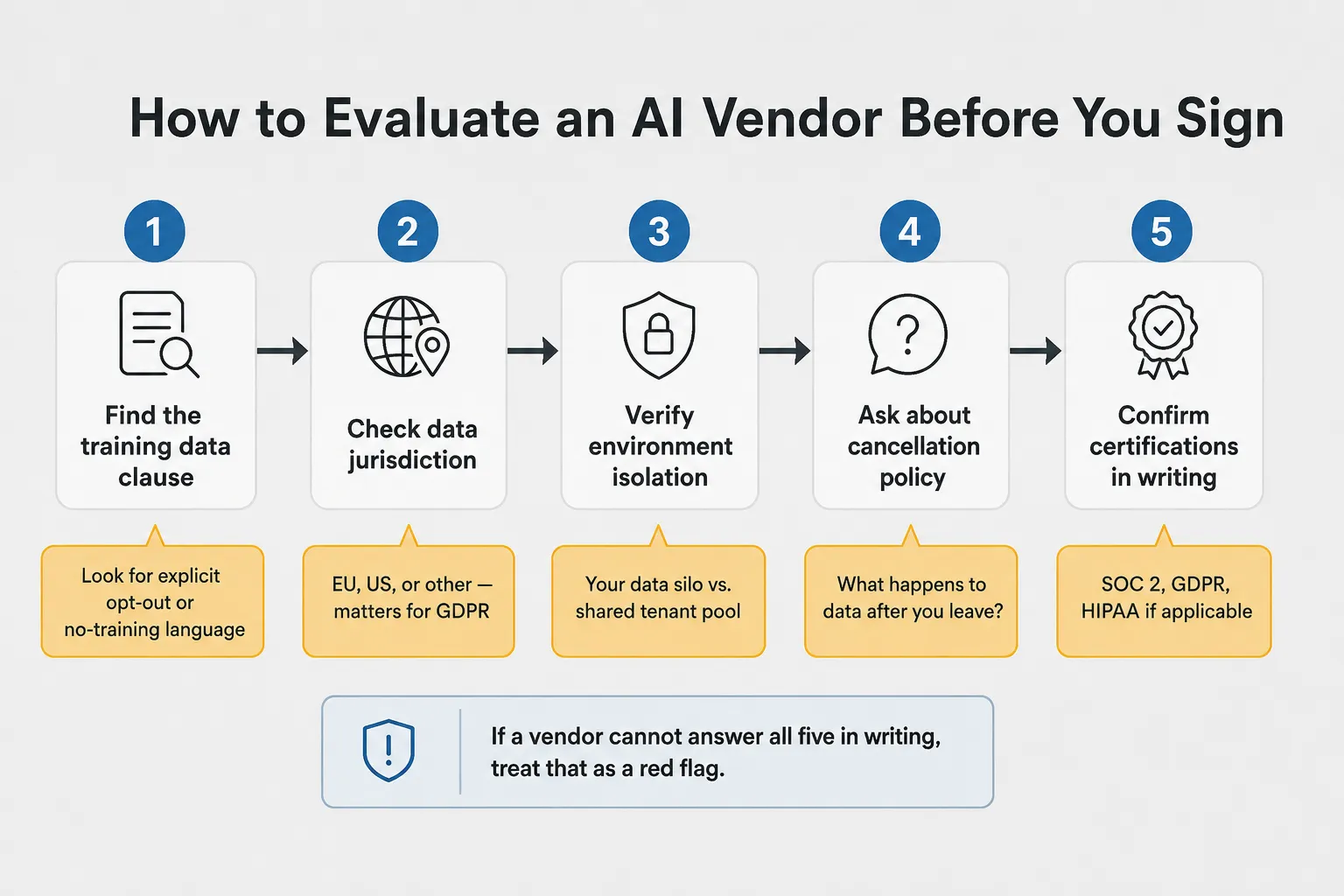
The Five Questions to Ask Before Signing Any AI Vendor Agreement
These five questions form a practical pre-signature checklist for any business evaluating an AI tool. They apply regardless of vendor size, product category, or price point.
- Does our data train your models, or any third-party models?
- Where is our data stored, and in what jurisdiction?
- Is our data environment isolated from other customers?
- What happens to our data if we cancel the service?
- Are you SOC 2 certified and GDPR compliant, and can you provide documentation?
If a vendor cannot answer all five questions clearly and in writing, that is an answer in itself. Ambiguity in a data training policy is not a minor administrative gap. For a business in a regulated industry, it is disqualifying.
Frequently Asked Questions
What is an AI vendor data training policy?
It is the contractual clause in an AI vendor’s terms of service that defines whether the vendor can use your inputs (conversations, documents, API calls) to train, fine-tune, or improve its AI models. It is separate from the storage or privacy policy and must be reviewed independently.
Is my data safe if I use a paid AI plan instead of a free one?
Not automatically. Paid consumer tiers sometimes include opt-out options but may still train on data by default. Only enterprise plans with explicit contractual exclusions provide reliable protection. Verify your plan’s specific terms in writing.
Can data that has already been used for AI training be removed?
No. Once data is embedded in model weights through training, you can’t selectively remove it. This is why the pre-contract review matters. There is no remediation path after the fact.
What industries face the highest risk from AI data training policies?
Law, finance, healthcare, and HR face the highest risk because confidentiality is a professional and legal obligation in these fields, not just a preference. Using an AI tool that trains on client data in these industries can breach privilege, violate HIPAA, or cause a regulatory compliance failure.
Does GDPR apply to AI vendor data training?
Yes. GDPR’s purpose limitation principle restricts repurposing personal data collected for service delivery for model training. EU data protection authorities have issued enforcement actions related to AI training practices, and businesses that share EU personal data with non-compliant AI vendors may face liability.
What is data isolation in the context of AI tools?
Data isolation means your data is processed in an environment that is separate from other customers’ environments. A vendor can offer data isolation and still train on your data. These are two separate commitments. Both need to be confirmed in the contract.
Do AI vendors sell customer data to other companies for training?
Reputable enterprise vendors do not. However, many AI products use third-party model providers as sub-processors, and those providers may have different policies. Always ask whether sub-processors receive your data and what their training policies are.
What is the difference between base model training and fine-tuning?
Base model training uses large public datasets to build the model’s foundational capabilities. Fine-tuning uses smaller, more specific datasets (which can include customer data) to improve performance on particular tasks. Both are forms of model training, and the vendor’s data policy should address both.
How do I know if my current AI vendor is compliant?
Request the data processing agreement and look for explicit language prohibiting training on customer data. If the vendor addresses this only in an FAQ or on a marketing page rather than in a signed contract, the commitment is not enforceable.
What should I do if my employees are already using free AI tools for work?
Treat it as an active data risk. Identify which tools are in use, review their default data training policies, and either migrate to a compliant enterprise platform or establish a clear policy prohibiting the use of non-enterprise tools for any business-related tasks.
Is “your data is private” the same as “your data won’t train our models”?
No. These are different commitments. A vendor can keep your data private (not share it with other users or third parties) and still use it internally to train models. Both commitments need to appear explicitly in the contract.
What certifications should a compliant AI vendor have?
At minimum, look for SOC 2 Type II certification and a GDPR-compliant Data Processing Agreement. Depending on your industry, you may also need HIPAA compliance documentation. Ask for documentation, not just claims.
How MacWorks 360 Helps With AI Vendor Evaluation
Part of what MacWorks 360 does is help clients evaluate technology decisions with the full picture in view: not just whether a tool works, but whether it is safe, compliant, and appropriate for how the business actually operates. AI vendor evaluation is an increasingly central part of that work.
The consultation process covers:
- Reviewing current AI tool usage across the organization and identifying data policy gaps.
- Evaluating prospective AI vendors against a structured checklist that includes training policy, data jurisdiction, isolation architecture, and compliance certifications.
- Helping clients migrate from consumer or free-tier AI tools to properly governed enterprise platforms.
- Advising on internal policies for AI tool use, including which tools are approved for which data types.
The goal is not to avoid AI. It is to use AI in a way that avoids legal, competitive, or reputational exposure. For businesses in regulated industries, that distinction is the difference between a productivity gain and a liability.
To discuss your current AI setup or get help evaluating a vendor agreement, reach out directly: macworks360.com | 973-671-1122.
MacWorks 360 | AI Security and Governance | August 2026
This article reflects publicly available information about AI vendor data practices as of August 2026. Vendor policies change. Always verify current terms directly with the vendor before signing any agreement.