Last updated: September 25, 2026
Quick answer
Goodweek is a governance layer that puts several AI models (GPT, Claude, Gemini, Mistral, DeepSeek) behind one managed workspace with role-based Team Spaces and centralized activity logs. ChatGPT Business/Enterprise, Claude Team/Enterprise, Gemini for Google Workspace, and Microsoft Copilot are single-vendor products with deeper native integration into their own ecosystems. The right choice depends on whether your organization wants multi-model flexibility with centralized oversight, or deep native integration with a suite you’ve already standardized on.
Key takeaways
- AI governance means controlling identity, access, data sources, and activity logs by default, not by asking employees to remember a policy.
- Goodweek’s core differentiator is one workspace across multiple AI models, reducing shadow AI and duplicate subscriptions.
- ChatGPT Business/Enterprise, Claude Team/Enterprise, Gemini for Workspace, and Microsoft Copilot each offer strong governance, but only within their own vendor ecosystem.
- Free or personal AI accounts are not comparable to any business or enterprise tier and should not be part of a governance evaluation.
- Claude and ChatGPT confirm no training on business/commercial data by default; Gemini and Copilot apply similar protections within their enterprise scopes (OpenAI, Anthropic).
- No platform, including Goodweek, replaces a written AI use policy covering permitted data, human review, and incident response.
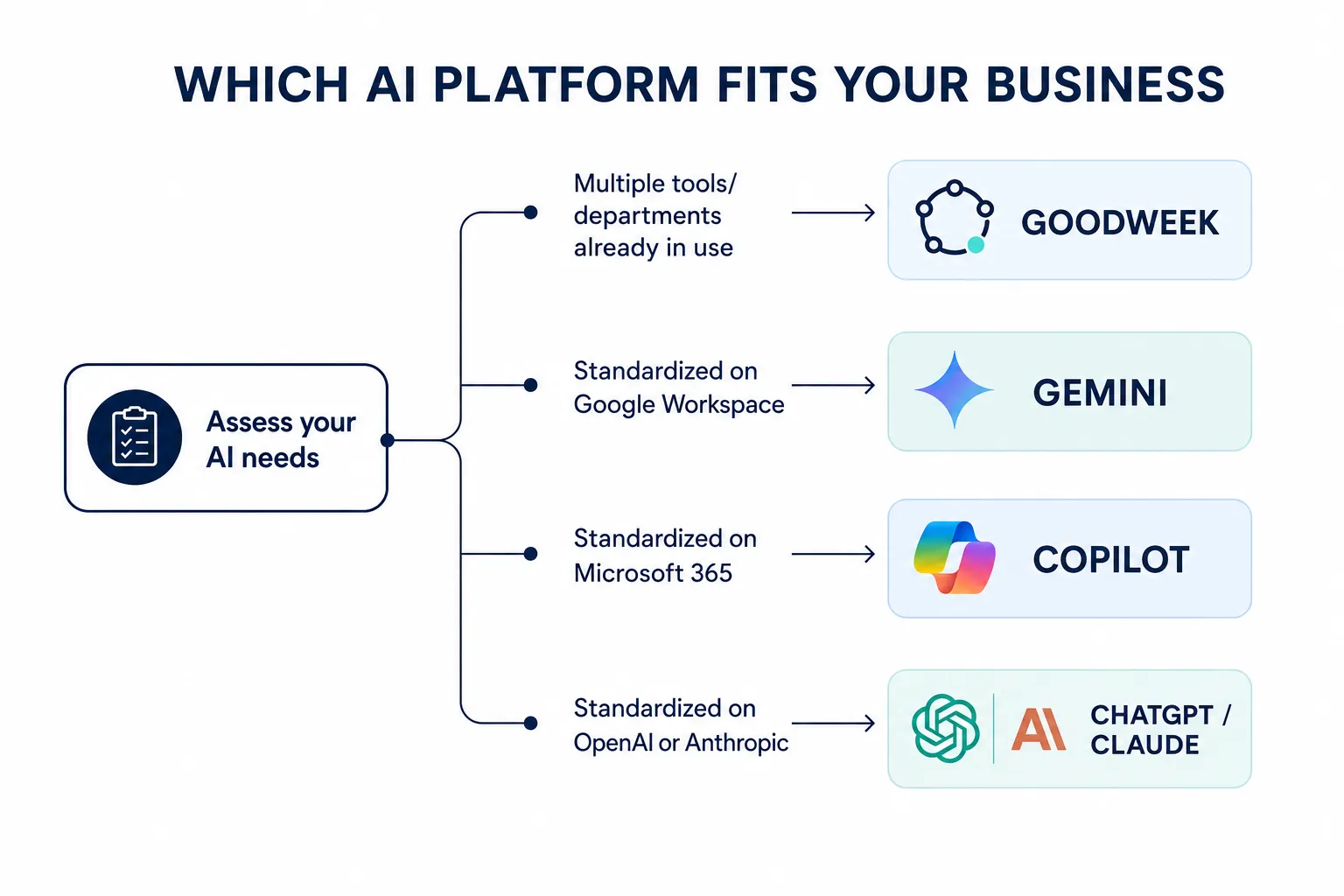
- The best fit depends on existing tool sprawl, department-level access needs, and whether you’re already committed to one vendor’s suite.
What is AI governance and why does it matter for business
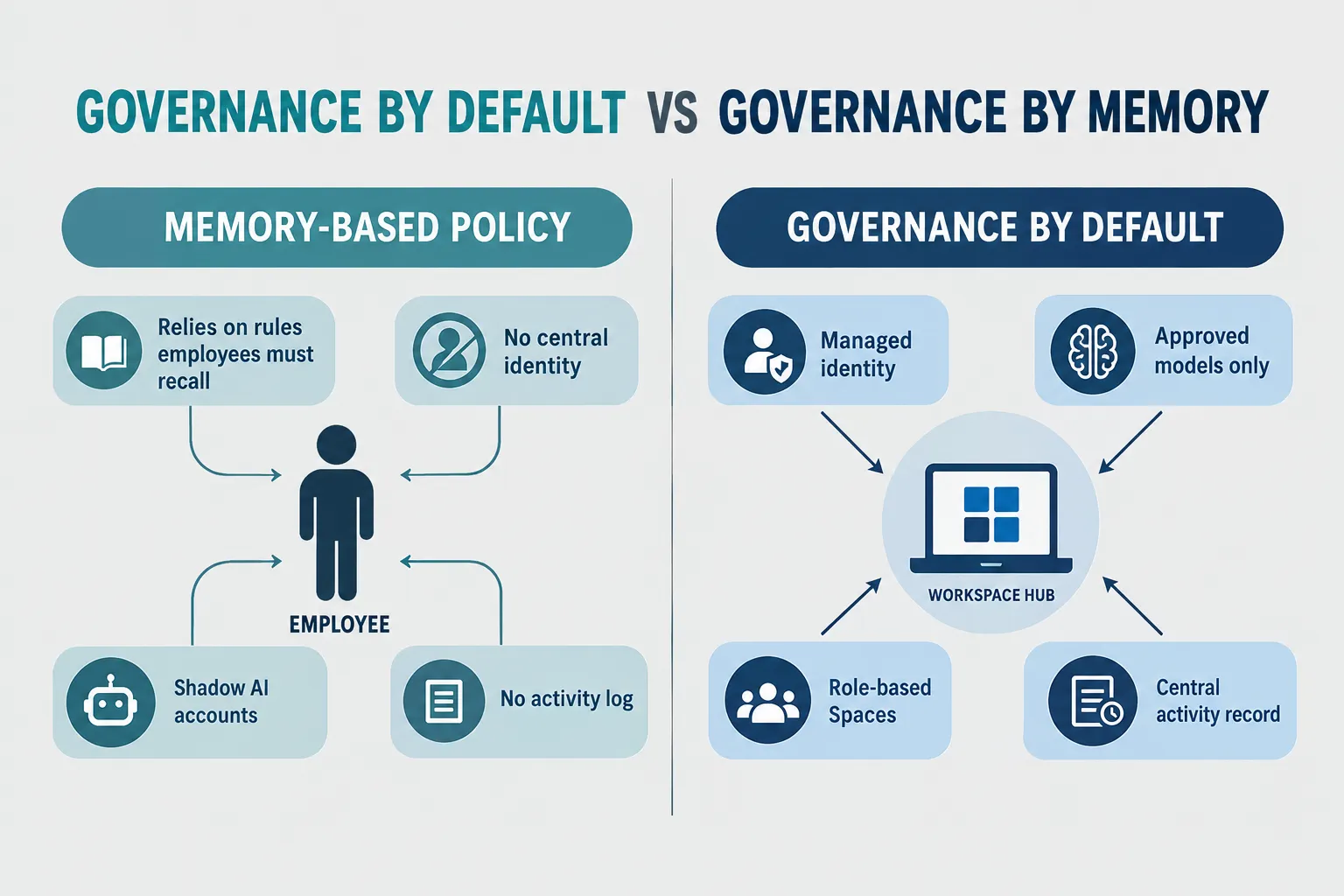
AI governance is the set of controls, most often identity management, access permissions, approved data sources, and activity logging, that determine how employees use AI tools at work. It matters because a written policy alone cannot stop someone from pasting client data into a personal ChatGPT account on their phone.
A governed setup changes the default behavior instead of relying on memory:
- Employees log in with a managed business identity, not a personal account.
- Only approved models and integrations are available inside the workspace.
- Departments get separate access and knowledge bases through role-based Spaces.
- Every prompt and response can be logged for oversight and audit.
Businesses in regulated industries, or any company handling client, financial, or health data, tend to need this structure most. For a deeper look at how unmanaged AI use creates exposure, see this breakdown of AI data privacy risks for small and midsize businesses.
How does Goodweek compare to ChatGPT for enterprise teams
Goodweek and ChatGPT Business/Enterprise both offer managed identity, access controls, and activity records, but they solve different problems. ChatGPT gives you the deepest access to OpenAI’s models and roadmap. Goodweek gives you OpenAI’s models plus Claude, Gemini, and others inside one governed workspace.
For teams standardizing entirely on OpenAI, ChatGPT Business or Enterprise offers a mature admin console, SAML SSO, SCIM provisioning, and an Admin API. For teams whose employees already bounce between ChatGPT, Claude, and Gemini on personal accounts, Goodweek consolidates that behavior into one login with consistent logging, which reduces shadow AI without forcing everyone onto a single model.
Choose ChatGPT Business/Enterprise if: your organization has already committed to OpenAI models and doesn’t need Claude or Gemini access inside the same workspace.
Choose Goodweek if: different teams already prefer different models and you need one place to govern all of them.
Can you use multiple AI models in one platform like Goodweek does
Yes. Goodweek’s platform routes GPT, Claude, Gemini, Mistral, and DeepSeek through a single managed workspace, rather than requiring separate subscriptions and logins for each (Goodweek Platform). This matters for organizations where marketing prefers one model for drafting, engineering prefers another for code, and legal wants a model with stronger reasoning for contract review.
The practical benefit is fewer standalone AI subscriptions to track, one identity system to audit, and one activity log instead of five. The tradeoff is that Goodweek depends on its contractual commitments with each underlying model provider, so it should verify retention and deletion terms directly in the customer agreement rather than assume them.
What’s the difference between ChatGPT Business and ChatGPT Enterprise
ChatGPT Business is built for smaller teams that need admin controls and default data protection without the full enterprise contract. ChatGPT Enterprise adds broader security certifications, higher usage limits, and more granular admin tooling, including SCIM-based provisioning and deeper API access (OpenAI Business Data).
- Both tiers exclude business data from model training by default.
- Enterprise typically includes stronger encryption guarantees and expanded compliance documentation.
- Business is often the right starting point for teams under roughly 150 seats; Enterprise fits larger, more regulated deployments.
Common mistake: assuming the free or Plus consumer tier includes the same data protections as Business or Enterprise. It does not.
Does Claude Team or Claude Enterprise have better audit logs
Claude Enterprise has stronger audit and retention capabilities than Claude Team. Both exclude commercial inputs from training by default, but audit logs, a Compliance API, and custom data retention windows are Enterprise-only features (Anthropic Enterprise).
If your compliance team needs exportable, timestamped logs of every AI interaction for a specific retention period, Claude Team’s default settings likely won’t satisfy that requirement on their own. Claude Enterprise closes that gap, and Goodweek’s centralized logging can serve a similar function across multiple models at once. However, the underlying audit depth still depends on what each connected model provider exposes.
How does Gemini for Google Workspace integrate with other tools, and which platform is best if you use Google Workspace?
Gemini for Google Workspace is built into Gmail, Drive, Docs, and Meet, so it reads and drafts within the tools employees already use daily. For organizations that run their entire business on Google Workspace, this native integration is usually the deciding factor over model choice (Google Workspace AI Security & Privacy).
Google states that Gemini does not use Workspace data outside the customer’s domain for training without explicit permission. The caveat is that this protection depends on admins configuring settings correctly at rollout, not on default settings.
Choose Gemini for Workspace if your organization is Google-centered and integration depth with Gmail/Drive/Docs matters more than access to multiple model providers.
What does Microsoft Copilot do with your Microsoft 365 data?
Microsoft Copilot processes prompts, responses, and Microsoft Graph data (emails, files, calendar, chats) to ground its answers in your organization’s own content. Microsoft states this data is not used to train the underlying foundation models in covered enterprise use (Enterprise data protection in Microsoft Copilot, Data, Privacy, and Security for Copilot).
The real-world protection depends heavily on configuration:
- Entra identity must be set up correctly for access boundaries to hold.
- Sensitivity labels need to be applied consistently across files.
- Microsoft Purview governance policies must be active to enforce retention and DLP.
Organizations already running Entra, sensitivity labels, and Purview at maturity get the most value from Copilot’s protections. Those without that foundation may see gaps between the vendor’s stated protections and what’s actually enforced.
How much does Goodweek cost compared to ChatGPT Business
Pricing for both platforms is subscription-based and changes with plan tier, seat count, and contract terms, so confirm specific figures directly with each vendor rather than assuming them from this guide. The more useful comparison is what each subscription replaces.
ChatGPT Business is a single-model subscription. Goodweek’s workspace can replace several separate AI subscriptions (a ChatGPT license here, a Claude license there, a Gemini add-on somewhere else) with one governed access point. For a company already paying for three or four separate AI tools across departments, the consolidation value often matters more than a line-by-line price comparison.
What happens to your data when employees use AI tools at work
What happens to workplace AI data depends entirely on which product tier is in use, not the AI tool’s brand name. Free and personal-tier AI accounts may use conversation data for model training and carry no enterprise-grade retention controls. Business and enterprise tiers across ChatGPT, Claude, Gemini, and Copilot generally exclude customer data from training by default, but retention periods, subprocessor access, and deletion timelines vary by contract.
Goodweek states that customer data never trains third-party models, a vendor claim worth verifying in the signed agreement, including any exceptions for feedback flows or subprocessors (Goodweek Security & Compliance). For a closer look at how vendor training policies differ across providers, review this guide to AI vendor data training policy.
Can you prevent employees from using personal ChatGPT accounts
You cannot fully prevent personal AI account use through policy alone, but you can make it unnecessary by providing an approved, managed alternative. Employees typically turn to personal accounts because no sanctioned option exists, or the sanctioned option is harder to use than the free tool they already know.
Practical steps that reduce personal-account use:
- Issue managed business identities for the platform you choose.
- Make the approved workspace at least as fast and capable as the free tools employees already use.
- Block or flag unauthorized AI domains at the network level where feasible.
- Route common use cases (drafting, research, coding) through the sanctioned platform’s integrations instead of copy-paste workflows.
What’s the difference between role-based access and Team Spaces
Role-based access controls what a user can do, while Team Spaces control what a user can see and work within. Role-based access might grant “editor” or “admin” permissions; a Team Space separates an entire department’s knowledge base, chat history, and connected data sources from another department’s.
Goodweek uses Team Spaces so that, for example, HR’s AI workspace doesn’t share chat history or knowledge with finance’s workspace, even though both sit inside the same platform. This is a meaningful distinction from a single shared chatbot instance where every user draws from the same undifferentiated context.
Do you need a separate AI policy if you use Goodweek
Yes. Goodweek and similar platforms can enforce and document more of a written policy, but they do not replace the policy itself. Organizations still need documented rules covering:
- What categories of data may or may not be entered into any AI tool
- When human review of AI output is required
- How intellectual property and confidential material are handled
- Record retention and incident response procedures if sensitive data is exposed
Companies building this from scratch should start with an AI governance framework for small business, then layer platform-level controls on top.
Which platform has the best data privacy protections for sensitive information
No single platform is universally “best” for sensitive data protection; the right answer depends on plan tier, configuration, and contract terms. ChatGPT Business/Enterprise, Claude Team/Enterprise, Gemini for Workspace, and Microsoft Copilot all state they exclude customer or commercial data from model training by default in their business tiers. Goodweek makes the same claim across the models it connects.
For regulated industries specifically, the deciding factor is often compliance documentation (SOC 2, GDPR alignment, sector-specific rules) rather than the AI feature set itself. Review this guide to AI data compliance in New Jersey covering SOC 2, GDPR, and the EU AI Act before finalizing a platform decision.
At-a-glance comparison
| Question | Goodweek | ChatGPT Business/Enterprise | Claude Team/Enterprise | Gemini for Workspace | Microsoft Copilot |
|---|---|---|---|---|---|
| Main strength | One governed workspace across multiple models | Mature OpenAI experience, broad enterprise controls | Strong Claude experience, coding, enterprise controls | Native Google Workspace context | Deep Microsoft 365, Entra, Purview fit |
| Model choice | GPT, Claude, Gemini, Mistral, DeepSeek | OpenAI models only | Anthropic models only | Google models only | Microsoft-selected models with M365 grounding |
| Training on customer data | Never trains third-party models (vendor claim) | No, by default for business tiers | No, by default for commercial tiers | No, outside domain without permission | No, for covered enterprise use |
| Best fit | Multi-model governance across departments | OpenAI-standardized orgs | Claude-standardized orgs | Google Workspace-centered orgs | Microsoft 365-centered orgs |
| Key caveat | Verify retention/deletion in contract | Strongest controls are plan-dependent | Audit/custom retention are Enterprise-only | Depends on correct admin settings | Depends on Entra, labels, Purview config |
A practical decision framework
Choose Goodweek when:
- Employees already use several AI tools or personal accounts
- Different departments need separate knowledge, access, and workflows
- Central logs and policy visibility across all AI use matter
- Avoiding dependence on a single model vendor is a priority
Consider a direct vendor product when:
- The company is already standardized on that vendor’s suite
- Native integration depth matters more than model choice
- IT already operates the vendor’s identity, retention, DLP, and audit stack
- A specialized feature (Claude Code, Purview) is decisive for your workflow
FAQ
Is Goodweek more secure than ChatGPT, Claude, Gemini, or Copilot?
Not universally. Security depends on plan tier, configuration, identity system, and contract terms for any platform. Goodweek is better aligned with governing multiple AI models and departments through one workspace, not with providing categorically stronger security than any single vendor’s enterprise tier.
Does Goodweek train AI models on customer data?
Goodweek states it never trains third-party models on customer data. Verify this claim in the signed customer agreement, including any exceptions, feedback flows, or subprocessor arrangements (Goodweek Security & Compliance).
Does Goodweek replace an AI use policy?
No. It can enforce and document more of an existing policy, but the organization still needs rules covering permitted data, human review, intellectual property, records, and incident response.
Is a free ChatGPT or Gemini account acceptable for business use?
No. Free and personal-tier accounts generally lack enterprise data protections, admin controls, and audit logging found in business and enterprise tiers.
Which platform integrates best with existing Microsoft 365 tools?
Microsoft Copilot, since it’s built directly into Microsoft 365, Entra, and Purview, offers integration depth that multi-model platforms cannot fully replicate.
Which platform integrates best with Google Workspace?
Gemini for Google Workspace, because it has native access to Gmail, Drive, Docs, and Meet.
Can one company use more than one of these platforms at once?
Yes, though it increases the number of identity systems, contracts, and audit logs to manage. This is exactly the fragmentation a multi-model workspace like Goodweek is designed to reduce.
Related reading
- AI governance for small business: what unmanaged AI use can cost you
- AI data privacy risks for businesses in 2026
- AI data compliance in New Jersey: SOC 2, GDPR, and the EU AI Act
- AI vendor data training policy explained
- ChatGPT overview
Need a governed AI pilot for your New Jersey business? MacWorks 360 can help map data, access, and workflows before committing to any platform. Contact MacWorks 360 or call Richard at 973-671-1122.
This guide is not legal, compliance, or cybersecurity advice. Vendor features and names change; information checked September 20, 2026.
Related Comparisons
- ChatGPT Secure Configuration Guide for Business Users
- Claude Code Secure Configuration Guide for Business Teams
- Goodweek vs ChatGPT for Business: Governance, Security and Model Choice
- Goodweek vs Claude Enterprise: Multi-Model AI Governance Compared
- Goodweek vs Gemini for Google Workspace Business: Which AI Fits Your Team?
- Goodweek vs Microsoft Copilot: AI Governance Compared for 2026