Last updated: September 25, 2026
Quick answer
Goodweek and ChatGPT Business/Enterprise solve related but different problems. ChatGPT gives direct access to OpenAI’s models with a mature enterprise product built around one vendor. Goodweek is a governed workspace that sits on top of multiple model families (GPT, Claude, Gemini, Mistral, DeepSeek) and adds role-based Spaces, policy alerts, and a single audit trail across all of them. Businesses already committed to OpenAI and satisfied with one model family typically do better with ChatGPT Enterprise. Businesses fighting shadow AI across several tools usually need Goodweek’s consolidation layer.
Key takeaways
- ChatGPT Business/Enterprise gives direct, deep access to OpenAI’s models plus SAML SSO and SCIM on qualifying plans.
- Goodweek positions itself as a governance layer above multiple model providers, not a replacement for any single one.
- Goodweek reportedly includes access to GPT models alongside Claude, Gemini, Mistral, and DeepSeek, according to Goodweek’s platform page.
- Neither platform’s marketing claims should substitute for contract-level verification of retention, training, and audit terms.
- Running both platforms without defined workflows can recreate the exact governance sprawl Goodweek is meant to solve.
- Shadow AI use (employees on personal ChatGPT, Claude, or Gemini accounts) is a strong signal that a consolidation platform is worth evaluating.
- IT and compliance teams should treat plan tier, not brand name, as the real variable in security comparisons.
What’s the difference between Goodweek and ChatGPT for Business
The core difference is scope. ChatGPT Business/Enterprise is a single-vendor product built around OpenAI’s models and OpenAI’s own connectors and compliance tooling, as described on OpenAI’s ChatGPT Enterprise page. Goodweek is a multi-model workspace that puts a governance layer, called Spaces, over several providers at once.
That distinction matters for planning:
- ChatGPT Enterprise optimizes for depth within one ecosystem, including native features OpenAI ships first to its own product.
- Goodweek optimizes for breadth and control, letting teams pick models by task while IT keeps one activity view.
- Neither approach is inherently more secure. They differ in where the governance boundary sits: inside one vendor’s platform, or across several.
Does ChatGPT Enterprise have the same governance controls as Goodweek
ChatGPT Enterprise offers strong governance for a single-vendor environment, but it does not natively cover activity happening in Claude, Gemini, or other tools employees may already be using. Goodweek’s pitch is a governance layer that spans multiple vendors from one console.
ChatGPT Enterprise includes workspace controls and, per OpenAI’s help center documentation, stronger compliance and audit features than lower-tier plans. Goodweek advertises Spaces, role-based controls, policy alerts, and full audit trails as standard. The practical question for buyers isn’t which vendor lacks security. It’s whether the business wants governance built around one AI product or governance that spans several.
Decision rule: If every AI tool your staff touches is OpenAI’s, ChatGPT Enterprise’s native controls may be sufficient. If staff also use Claude, Gemini, or other tools informally, a single-vendor governance layer leaves gaps.
Can Goodweek access GPT models, or just Claude and Gemini
Goodweek says its platform includes access to OpenAI’s GPT models in addition to Claude, Gemini, Mistral, and DeepSeek, per Goodweek’s business page. That means choosing Goodweek does not mean giving up GPT access.
Model availability details worth confirming before purchase:
- Which specific GPT versions are included and whether they lag behind OpenAI’s own release schedule.
- Whether all five model families are available on every Goodweek plan tier or only higher tiers.
- Whether feature parity (vision, code execution, connectors) matches what each model offers natively.
How much does Goodweek cost vs. ChatGPT Business?
Pricing for both platforms is plan-dependent and should be confirmed directly with each vendor before budgeting. OpenAI publishes tiered pricing for ChatGPT Business and Enterprise on its business pricing page, with Enterprise typically requiring a sales conversation for volume and contract terms.
Goodweek’s public pages do not list fixed per-seat pricing in the sources reviewed for this comparison; request quotes directly. Cost comparisons should account for:
- Per-seat licensing versus usage-based components.
- Whether multi-model access on Goodweek reduces the need for separate subscriptions to Claude or Gemini elsewhere.
- Integration and onboarding costs, since 45+ read/write integrations is a vendor claim that should be validated against your actual tool stack.
Which platform is better for audit trails and compliance
For businesses running AI activity across multiple providers, Goodweek’s consolidated audit trail is generally the stronger fit because it captures activity in one place regardless of which model handled a given task. For businesses standardized entirely on OpenAI, ChatGPT Enterprise’s native audit and compliance tier can be sufficient.
Before deciding, confirm with either vendor:
- What content is retained, for how long, and how deletion actually works.
- Whether an administrator can see and export records needed for an internal investigation.
- Whether contractual commitments match what the marketing page states, since claims and contracts can diverge.
Businesses in regulated industries should also review how AI vendor data-training policies intersect with existing compliance obligations; see this breakdown of AI vendor data training policy considerations for a fuller checklist.
Is our data safer with Goodweek or ChatGPT Enterprise?
Neither platform is automatically “safer” in the abstract. OpenAI states that data from its business products and API is not used to train models by default, according to OpenAI’s enterprise privacy page. Goodweek makes a similar vendor claim that customer data never trains third-party models. Verify both claims against the contract, not just the marketing page.
Practical safety depends more on configuration than brand:
- SSO/SCIM enforcement (available on both, plan-dependent).
- Connector permission scope and how quickly access can be revoked.
- Retention and deletion settings applied at the workspace level.
For a broader look at where AI tools introduce risk regardless of vendor, see this overview of AI data privacy risks for small and mid-size businesses.
Do we need Goodweek if we already have ChatGPT Enterprise, and which one fits shadow AI problems
A business already fully standardized on ChatGPT Enterprise, with no other AI tools in use, generally does not need Goodweek. A business where shadow AI already spans several tools and personal accounts is a strong candidate for Goodweek’s consolidation model.
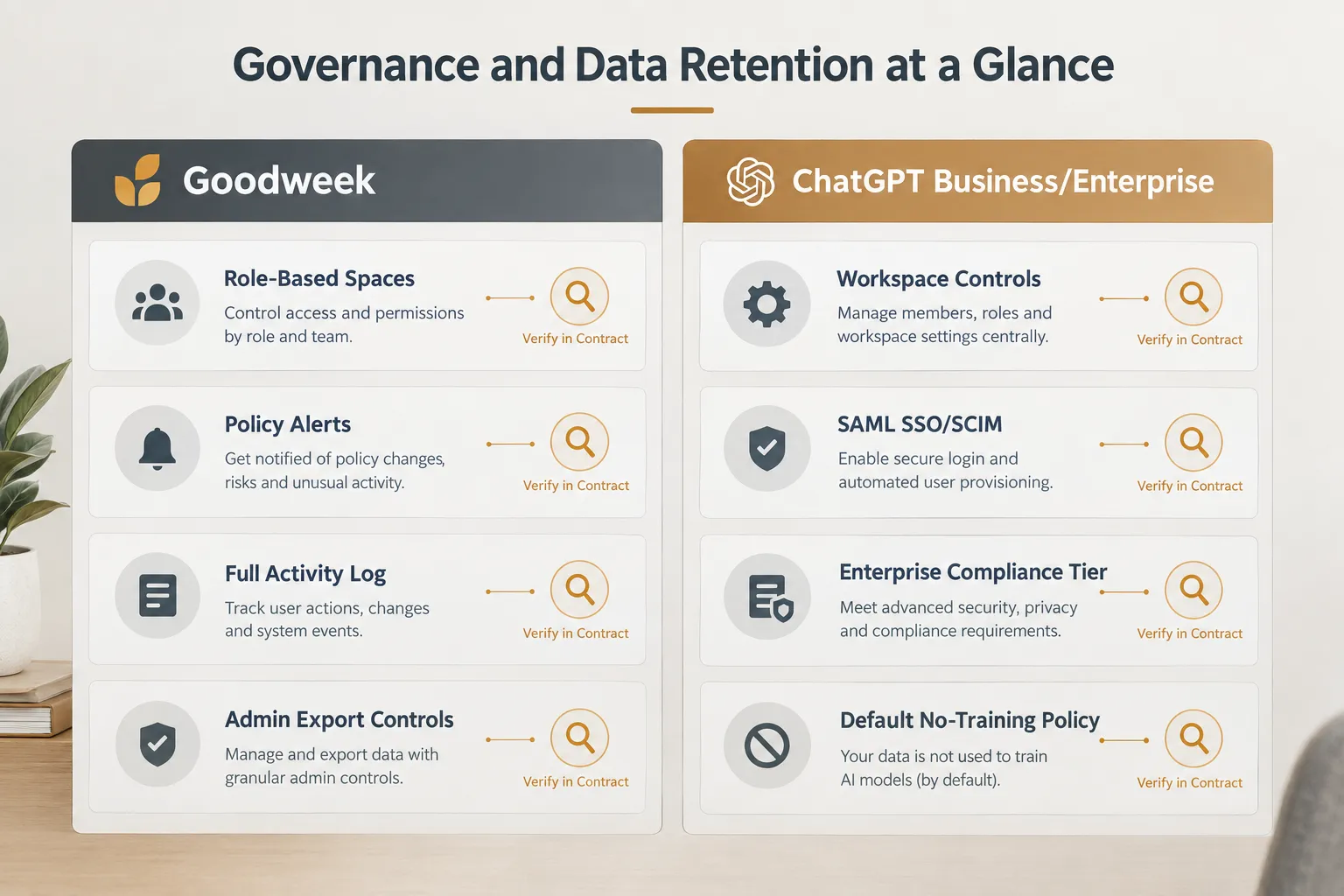
Choose ChatGPT Enterprise if:
- Staff specifically want OpenAI’s newest native functions first.
- The company already standardized on ChatGPT Enterprise and connectors meet every use case.
- Adding multiple models would create complexity without a clear benefit.
Choose Goodweek if:
- Shadow AI already spans several tools and personal logins.
- Different teams need separate data and workflow boundaries.
- Model choice matters by department or task type.
- Leadership wants one consolidated view for audit and policy enforcement.
For a deeper look at why shadow AI use tends to snowball inside organizations, review this guide on AI governance for small business.
What happens if we use both Goodweek and ChatGPT at the same time
Running both platforms simultaneously is possible, but without defined boundaries, it recreates the exact governance sprawl Goodweek exists to reduce. IT ends up managing two separate identity systems, two retention policies, and two audit trails instead of one.
Before allowing both:
- Define which workflows run through Goodweek and which stay in ChatGPT.
- Assign identities by platform so employees don’t duplicate accounts.
- Classify data types so sensitive records only flow through the approved tool.
Can employees still use personal ChatGPT if we buy Goodweek
Buying Goodweek does not automatically stop employees from using personal ChatGPT accounts unless the business enforces a policy blocking it. This is a common oversight: consolidation works only if you explicitly restrict personal-account use through device management, network policy, or written acceptable-use rules.
Businesses that skip this step often discover, months later, that shadow AI usage continued alongside the new governed platform, defeating the purpose of the purchase.
How do I set up role-based access in Goodweek vs ChatGPT
Goodweek organizes access through Spaces, where roles determine what a user or team can see and do within a governed workspace. ChatGPT Business and Enterprise handle this through workspace controls, with SAML SSO and SCIM available on qualifying plans for automated provisioning and deprovisioning.
Setup steps generally follow this order on either platform:
- Confirm SSO/SCIM availability on your specific plan tier.
- Map organizational roles to platform permission levels before rollout.
- Pilot with one department before expanding company-wide.
- Audit access quarterly, since role drift is common as staff change positions.
What integrations does Goodweek have that ChatGPT doesn’t
Goodweek advertises more than 45 read/write integrations as a vendor claim, aimed at reducing manual copy-pasting between tools. ChatGPT offers OpenAI’s own connectors and enterprise integrations, though the scope varies by plan and is generally narrower in vendor count since it’s built around a single ecosystem.
Before treating either integration count as a deciding factor:
- Confirm which specific tools in your stack are actually supported, not just the total number claimed.
- Test read/write permissions in a sandbox before granting production access.
- Check how connector permissions are limited and revoked if an employee leaves or a tool is deprecated.
How long does each platform keep our chat history?
Retention periods depend on the plan on both platforms and should be confirmed directly, not assumed from general marketing statements.OpenAI states that business and API data is not used for training. However, retention length for operational purposes can still vary by contract tier, per OpenAI’s business data policy. Request Goodweek’s retention terms in writing before purchase, since the sources reviewed here did not detail specific timeframes.
Ask both vendors directly:
- What is the default retention window, and can you shorten it in the contract?
- How is deleted content actually purged from backups?
- Can retention differ by data classification (e.g., legal, HR, finance)?
Frequently asked questions
Does ChatGPT train on business data?
OpenAI states that data from its business products and API is not used to train models by default. Personal ChatGPT accounts and opt-in feedback follow different rules, so business use and personal use should not be treated the same way.
Does Goodweek include ChatGPT?
Goodweek says its platform provides access to OpenAI’s GPT models along with Claude, Gemini, Mistral, DeepSeek, and others. Confirm exact model versions and feature availability per plan before purchase.
Can a company use both platforms?
Yes, but overlapping tools without defined boundaries can recreate the governance sprawl Goodweek is meant to reduce. Define approved workflows, identities, and data classes before allowing both.
Which platform is easier to roll out for a small team?
A single-vendor rollout with ChatGPT Enterprise is usually faster for teams with no existing multi-model use. Goodweek’s setup takes longer upfront because it maps roles across multiple providers, but it pays off if shadow AI is already widespread.
Is model choice actually valuable, or is it just marketing?
Model choice matters when different tasks benefit from different strengths (writing versus code versus reasoning), and it matters less if a business does only one type of AI-assisted work.
What’s the biggest mistake businesses make when comparing these two?
Comparing marketing pages instead of actual contracts. Retention, training, and audit terms should be verified in writing against the specific plan being purchased, not assumed from a features table.
For businesses evaluating compliance obligations alongside this decision, this guide to AI data compliance requirements in New Jersey covers SOC 2, GDPR, and EU AI Act implications relevant to either platform choice. Businesses wanting a broader primer on generative AI tools can also review MacWorks 360’s AI resource hub and its dedicated ChatGPT overview page.
Start with a controlled pilot workflow and compare governance requirements before comparing feature lists. Contact MacWorks 360 for guidance: macworks360.com/contact or call Richard at 973-671-1122.
Related Comparisons
- ChatGPT Secure Configuration Guide for Business Users
- Claude Code Secure Configuration Guide for Business Teams
- Goodweek vs ChatGPT, Claude, Gemini, and Microsoft Copilot: A Business AI Governance Guide
- Goodweek vs Claude Enterprise: Multi-Model AI Governance Compared
- Goodweek vs Gemini for Google Workspace Business: Which AI Fits Your Team?
- Goodweek vs Microsoft Copilot: AI Governance Compared for 2026